Hidden in the cloud forests of northern Peru, the Amazonas region is one of the country’s most archaeologically rich — and least visited — destinations. Understanding where each site sits, how long it takes to reach, and what to expect on arrival is essential to planning an experience that is both rewarding and realistic. This guide maps out the key destinations across the Chachapoyas region, so you can appreciate the geography before you go and make the most of every day on the ground.
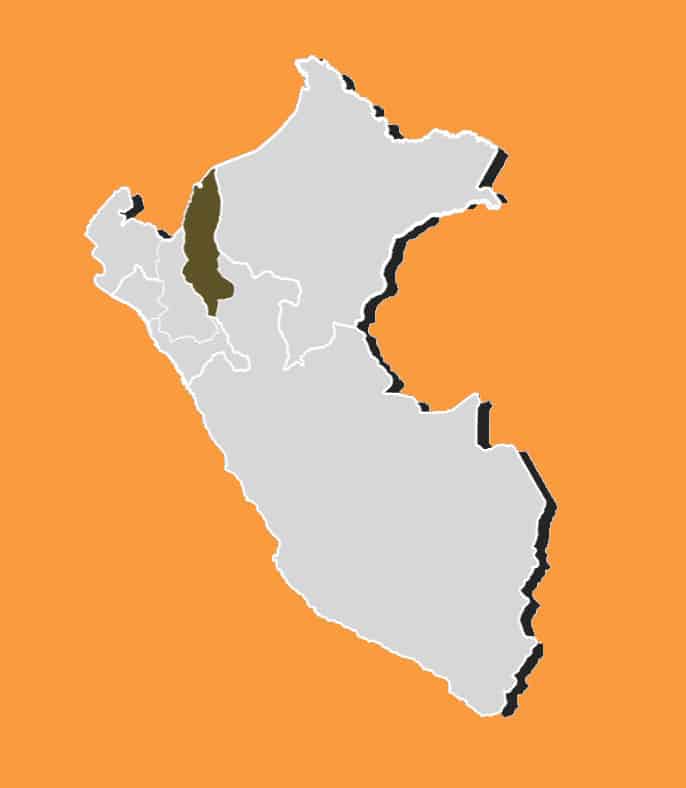
Chachapoyas is the capital of Peru’s Amazonas Region, situated in the northeast of the country on the eastern slopes of the Andes — in the zone Peruvians call the ceja de selva (the “eyebrow of the jungle”), where Andean highland gives way to the upper Amazon basin. It sits at 7,657 feet (2,335 metres) above sea level, significantly lower than Cusco, making altitude sickness far less of a concern for most visitors.
Getting here is part of the adventure!
There are no direct international flights to Chachapoyas. Most travelers fly into Lima, then take a domestic flight to Jaén (the preferred option for speed and comfort) followed by a scenic four-hour private transfer over mountain roads.
Alternatively, comfortable long-distance buses connect the coastal city of Chiclayo to Chachapoyas in approximately eight hours on a well-maintained highway — a good option if you are combining northern coastal and highland destinations.
Altitude: 2,335 m / 7,657 ft above sea level
Temperature: 10–26°C (50–78°F) — cool mornings, warm afternoons
Rainy Season: December to March (waterfalls at their peak; some trail closures possible)
Dry Season: May to September (optimal trekking, clearer skies)
Best base for all excursions: Chachapoyas town (comfortable colonial hotels)
Nearest airport: Jaén (~4 hours overland); small local airport with limited schedules
To book your Chachapoyas tours now or consult with us, fill out the “Contact Us” form and a Fertur Peru Travel coordinator will contact you within one working day with detailed information about your fully customizable trip.
Fertur Peru Travel’s pledge is to offer you top-quality, individualized attention that starts with the planning of your trip and continues through your journey to guarantee a great vacation.
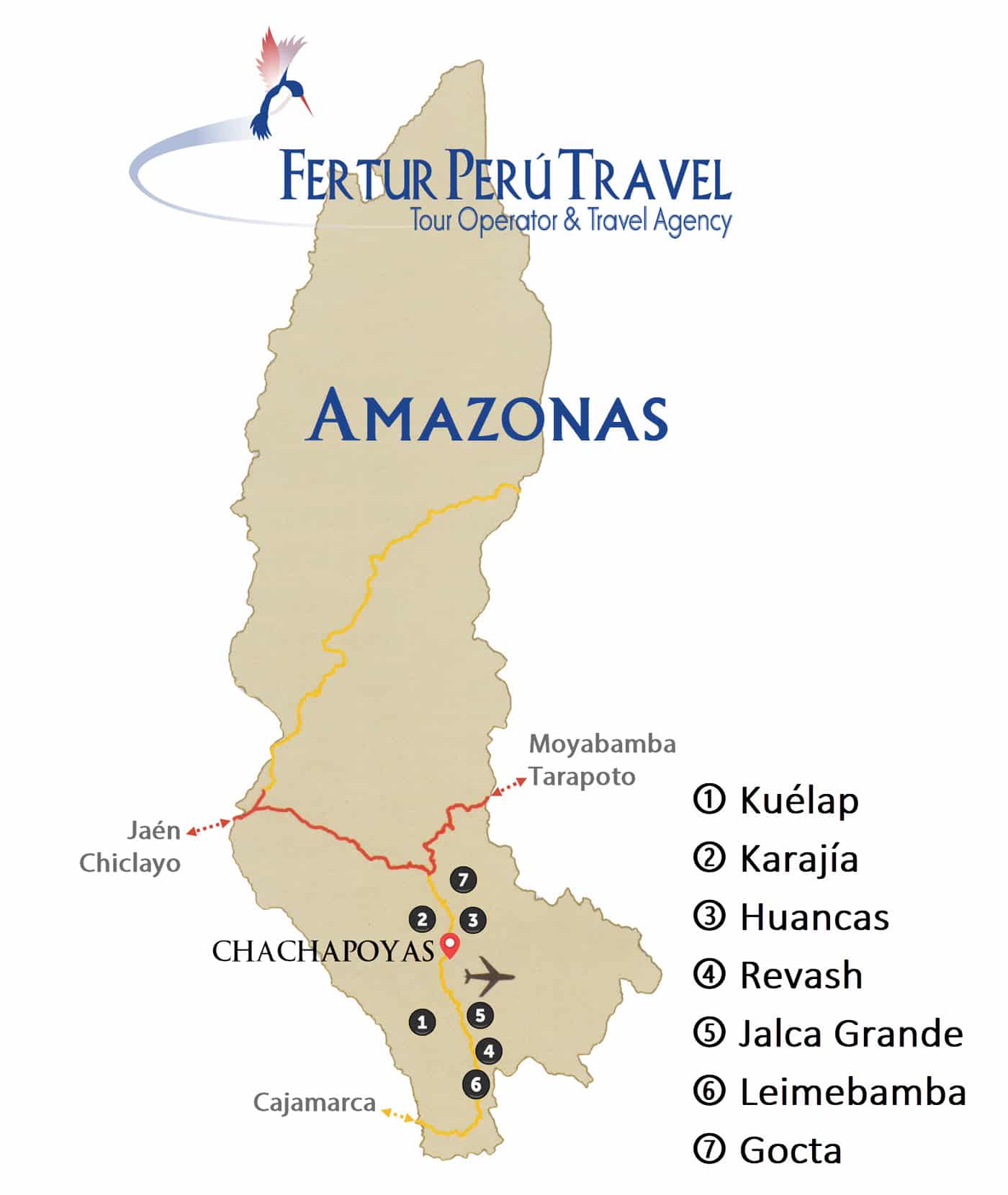
The map below marks the seven principal destinations that form the backbone of our custom Chachapoyas itineraries. Chachapoyas town is the natural hub — almost every major attraction radiates outward from it, ranging from a short drive to a half-day journey.
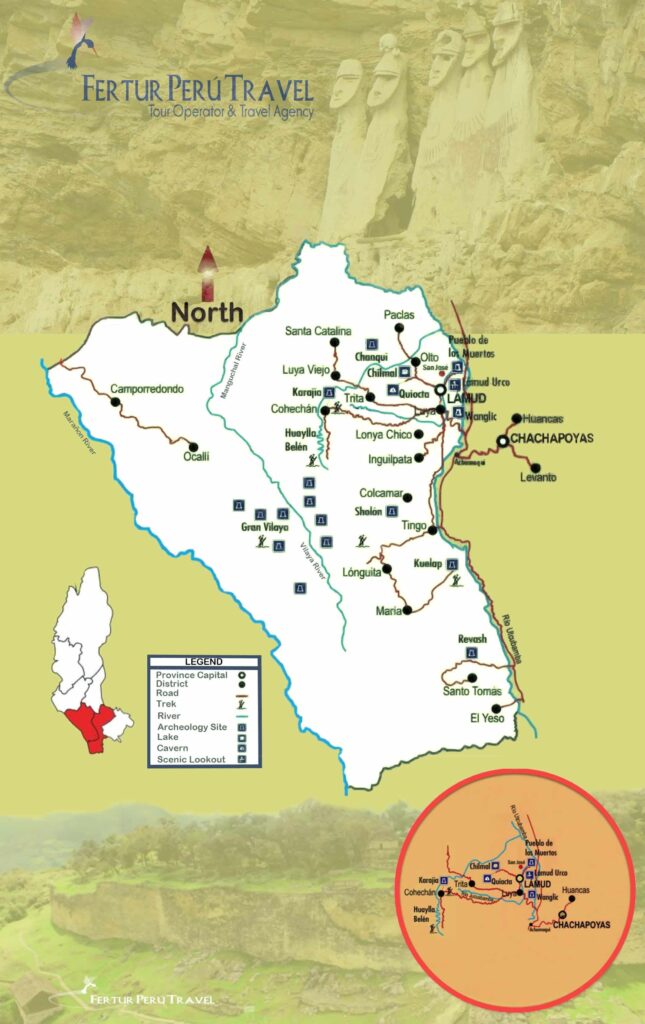
Within a radius of roughly 60 kilometres from Chachapoyas town, you will find fortress cities, cliff tombs, cave systems, ceramic-producing villages, and dramatic viewpoints — many of them still little-visited. The rivers Utcubamba, Marañón, and Vilaya cut through deep gorges, shaping the landscape and often serving as navigational landmarks on overland transfers. The density of heritage here rivals anywhere in Peru — what sets Chachapoyas apart is how rarely you’ll share it with a crowd.
Each of the main sites demands its own planning. Below is a practical breakdown of what to expect at every destination — distances, visit durations, physical requirements, and logistical details that matter on the day.
Distance from Chachapoyas: ~34 miles (55 km) southwest | approx. 1 hr drive to Tingo Nuevo cable car station
Visit Duration: Half day to full day (allow 4–6 hours on-site)
Difficulty: Moderate — 1 mile (1.5 km) walk from cable car arrival to citadel entrance; uneven stone paths inside
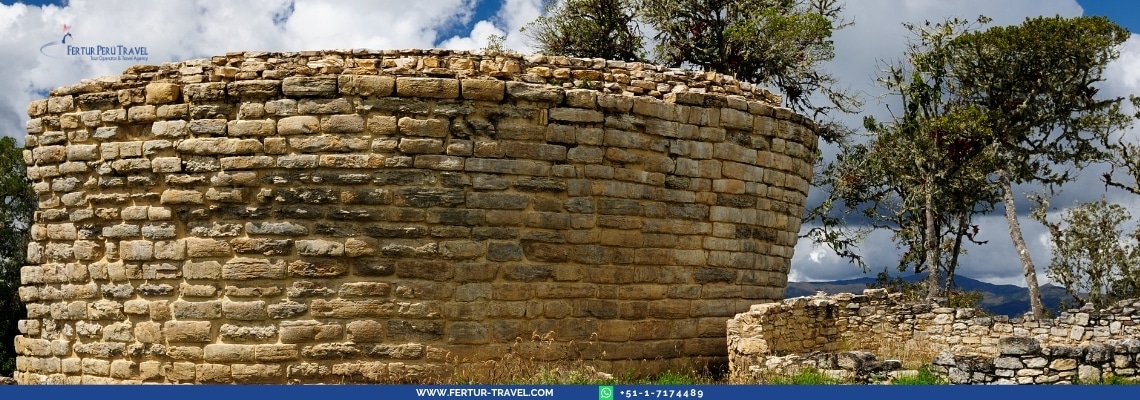
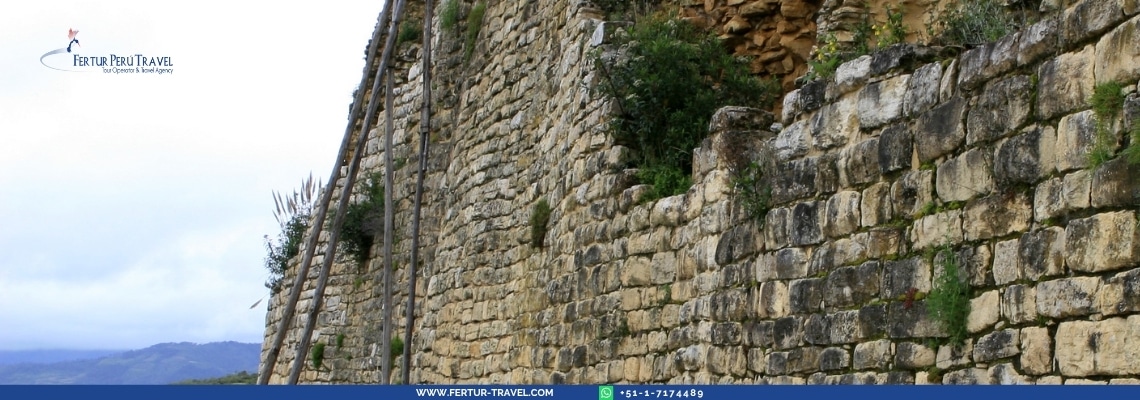
Highlight: Massive pre-Inca walled citadel at 9,800 ft (3,000 m) above sea level, containing over 400 circular stone dwellings Logistics: Cable car from Tingo Nuevo takes ~20 minutes and offers panoramic valley views. Service may pause in high winds; Fertur guides monitor conditions and adjust schedules. Entrance fee included in tour packages. Bring layers — temperatures drop noticeably at altitude.
Kuélap is the region’s crown jewel, and with good reason. Canadian historian John Hemming estimated its construction used three times the building material of the Great Pyramid at Giza. Its 65-foot (20-metre) limestone walls enclose more than 400 circular stone houses, a handful of which have been partially restored. Inside, look for the distinctive trapezoidal friezes and carvings believed to represent the eyes of pumas and snakes — hallmarks of Chachapoya artistic style.
Unlike Machu Picchu, you will rarely share Kuélap with more than a handful of other visitors. That solitude is part of what makes it extraordinary. Plan for an early departure from Chachapoyas (6:30–7:00 AM) to arrive at the cable car station when it opens and enjoy the fortress in the soft morning light before cloud cover builds.
Distance from Chachapoyas: ~31 miles (50 km) north | approx. 1.5 hrs drive + 45–60 min hike
Visit Duration: Half day (3–4 hours including transfer)
Difficulty: Moderate — hike involves some steep sections; sarcophagi are viewed from across the canyon
Highlight: Seven 6.5-foot (2-metre) tall anthropomorphic clay funerary figures, set into a sheer cliff face
Logistics: Drive to the Cruz Pata area near La Peca, then hike to the viewpoint above the Utcubamba River. No direct access to the cliff — the best views are from the opposite side. A good telephoto camera lens significantly enhances the experience. Often combined with Kuélap on a full-day itinerary.
The Karajía Sarcophagi are among the most visually arresting archaeological sites in all of Peru. Seven larger-than-life figures stare out from the cliff with an eerie authority, their white geometric painted designs still visible after more than 500 years. Built in the 15th century, these funerary statues are believed to have held the mummified remains of Chachapoya’s highest-ranking individuals, placed high above the living as a sign of status and spiritual connection to the sky.
Distance from Chachapoyas: ~5 miles (8 km) north | 2-hour hike or short drive
Visit Duration: Half day (3–4 hours)
Difficulty: Easy to moderate — good paths; viewpoint requires short walk
Highlight: Traditional pottery village with dramatic views over the Sonche Canyon and Utcubamba Valley
Logistics: One of the easier excursions to combine with a morning in Chachapoyas town. The hilltop position of the village provides jaw-dropping canyon views. Local artisans continue pottery traditions unchanged for generations. Often used as an acclimatisation excursion early in a tour.
Distance from Chachapoyas: ~37 miles (60 km) south | approx. 1.5–2 hrs drive + 30–45 min hike from San Bartolo
Visit Duration: Half day (4–5 hours including transfer)
Difficulty: Moderate — drive through cloud forest followed by a rewarding trail hike
Highlight: Cliffside mausoleums in ochre and white, with painted walls depicting animals and geometric designs
Logistics: Route passes through dramatic cloud forest scenery. Hike from San Bartolo village leads to clear views of the mausoleum chambers built into the limestone ledges. Red ochre paintings are particularly vivid in good light. Best visited in the morning. A favourite among photography-focused travellers.
Where Kuélap is about scale and mass, Revash rewards with intimacy and colour. The small house-like tombs, painted in warm ochres and whites and nestled impossibly into narrow cliff ledges, speak to the remarkable ingenuity of Chachapoya builders and the importance their culture placed on the protection of the dead. The surrounding cloud forest adds another dimension — the hike in is as memorable as the site itself.
Distance from Chachapoyas: ~25 miles (40 km) south | approx. 1 hr drive
Visit Duration: 2–3 hours
Difficulty: Easy — town walking, flat terrain
Highlight: Colonial church with Chachapoya-era carved designs; small community museum; Ollape ruins nearby
Logistics: A living town where traditional highland culture remains visible. The church’s unique hybrid architecture — Spanish colonial structure with pre-Inca decorative motifs — reflects the region’s layered history. The nearby Ollape Archaeological Complex is a five-minute drive. Easily combined with Gocta Falls or Revash.
Distance from Chachapoyas: ~25 miles (40 km) south | approx. 1 hr drive
Visit Duration: Half day (3–4 hours), or full day if combining with Lake of the Condors
Difficulty: Easy (museum visit) to strenuous (full Lake of the Condors trek)
Highlight: Over 200 Chachapoya mummies and funerary artifacts rescued from cliff tombs above Laguna de los Cóndores
Logistics: The modern Mallqui Central Museum provides essential context before visiting any field sites. The mummies, clothing, ceramics, and weapons recovered in 1997 represent one of Peru’s most significant archaeological finds of recent decades. The full hike to the Lake of the Condors is a multi-hour, strenuous undertaking — arrange in advance with Fertur if interested.
Leimebamba is a pleasant, unhurried town that makes an excellent contrast to a morning at an open-air archaeological site. The museum’s director, archaeologist Sonia Guillén, led the rescue operation that saved 219 mummy bundles from looters, and the institution she has built reflects both scientific rigour and genuine community connection. A visit here transforms the cliff tombs seen elsewhere in the region from curiosities into deeply human stories.
Distance from Chachapoyas: ~28 miles (45 km) north | approx. 1–1.5 hrs drive + 3–4 hr return trek
Visit Duration: Full day
Difficulty: Moderate — well-maintained trail through cloud forest, some elevation gain
Highlight: One of the world’s highest waterfalls at 2,530 feet (771 metres), plunging in two dramatic cascades through protected cloud forest
Logistics: Trail begins from the village of Cocachimba (upper falls) or San Pablo (lower falls). Horses available for the first section. The surrounding cloud forest is protected and shelters toucans, monkeys, the Andean cock-of-the-rock, and puma. Allow a full day and depart by 7:00 AM.
Gocta was known to local communities for centuries but only officially measured and registered with the international geographic community in 2006. Standing at the base of either cascade — surrounded by cloud forest, constant mist, and the roar of the falls — is an experience that justifies an entire trip. Bring waterproofs and be prepared to get wet. The wet season (November to March) produces maximum water flow; the dry season offers clearer skies and easier trail conditions.
No two Chachapoyas itineraries are the same — and that flexibility is one of the destination’s great strengths. Below are the most practical ways to combine these sites, depending on the time you have available.
With a short stay, prioritise Kuélap (full day), Gocta Falls (full day), and your choice of Karajía or Revash (half day each). This covers the region’s three headline attractions and leaves time to explore Chachapoyas town on arrival. Most of our 4-day packages are built around this combination.
An extended stay allows you to add Leimebamba and the Mallqui Museum, the Revash Archaeological Complex, Jalca Grande, and the Huancas pottery village — as well as optional cave exploration at Caverna de Quiocta. You’ll also have time to slow down: linger over an afternoon in a village, take an optional birding walk at dawn, or explore Chachapoyas’ colonial centre at your own pace.
Chachapoyas pairs beautifully with the archaeological treasures of Chiclayo on Peru’s northern coast. Add the Lord of Sipán Museum, the Túcume pyramids, and the Brüning Museum to your itinerary and you’ve assembled one of the most comprehensive pre-Columbian archaeology journeys anywhere in South America. For the truly adventurous, the route can continue east toward Tarapoto and the upper Amazon basin.
Prices available upon request
Prices starting from $925 per person
Prices starting from $1,043 per person
Contact telephone numbers
Offices