When the June 2026 issue of National Geographic reached readers, it introduced a Peruvian archaeological…
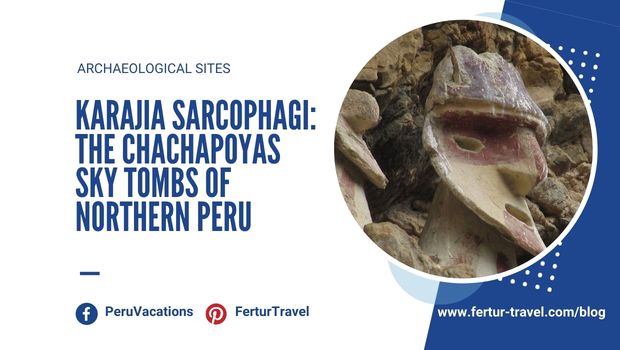
Karajia Sarcophagi: The Chachapoyas Sky Tombs of Northern Peru
High on a sheer limestone cliff in the cloud forest of northern Peru, a row of imposing figures gazes out over a deep river gorge. They are not statues. They are the dead, the Karajia sarcophagi.
Also often spelled Carajía, these are among the most extraordinary funerary monuments in South America: towering anthropomorphic burial capsules created by the ancient Chachapoyas on an almost inaccessible cliff face. Remote, dramatic, and still little visited, they remain one of the most haunting archaeological attractions in northern Peru.
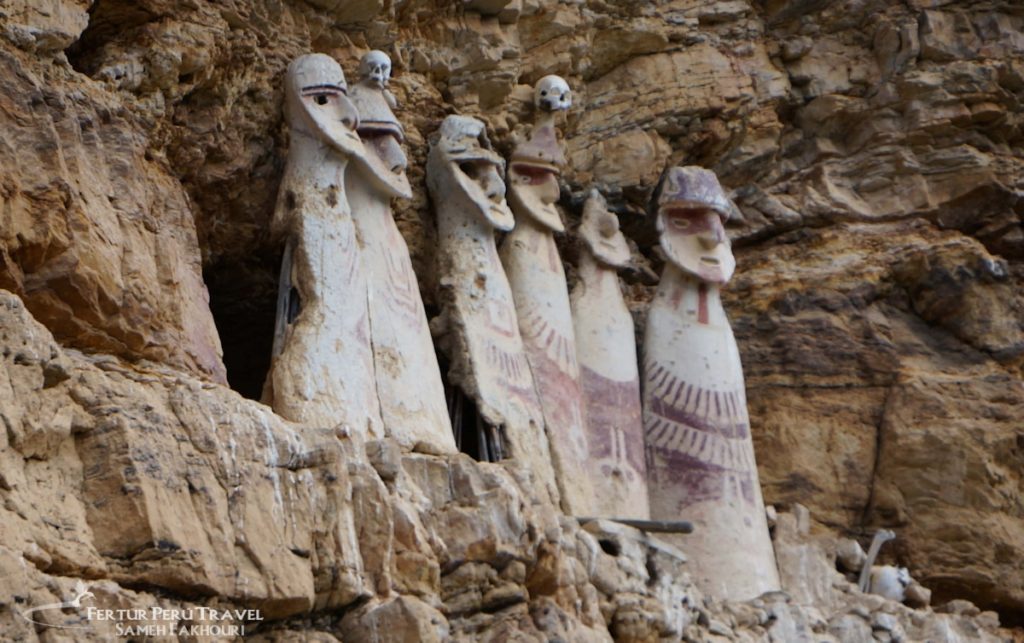
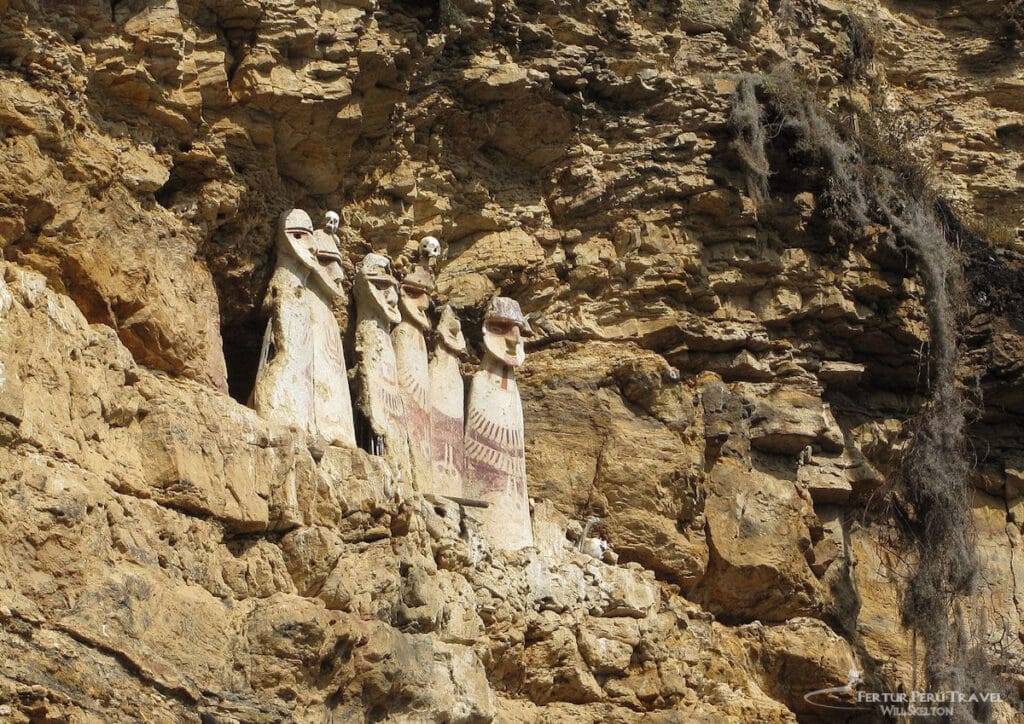
The extraordinary Karajia sarcophagi seven towering pre Columbian clay funerary figures some reaching up to 25 meters in height dramatically set into a vertical cliff face at over 3000 meters above sea level in the Amazonas region of northern Peru Created by the ancient Chachapoya culture between the 14th and 15th centuries these remarkable anthropomorphic coffins adorned with elongated skull shaped heads and painted geometric designs overlook the Utcubamba Valley and remain one of the most visually striking and least visited archaeological wonders of Peru
For travelers interested in ancient Peru beyond the country’s best-known sites, Karajía offers something rare: a direct encounter with a civilization that is still less familiar than the Inka, yet left behind one of the most distinctive mortuary traditions in the Andes. These Chachapoyas sarcophagi are not only visually unforgettable. They also open a window onto a culture that understood ancestry, death, landscape, and memory in deeply symbolic ways.
Where are the Karajia sarcophagi?
The Karajía sarcophagi are located in Luya province, in the Amazonas region of northern Peru, within excursion range of the city of Chachapoyas. The site lies near the community of Cruzpata, in the wider Utcubamba basin area associated with some of the most remarkable Chachapoyas ruins and funerary sites in Peru.
That is part of what makes Karajía Peru so compelling. You are not simply visiting an isolated archaeological monument. You are entering a broader cultural landscape of cloud forest valleys, ridge-top settlements, cliff tombs, painted mausoleums, and traditional villages that still feels far removed from Peru’s main tourist circuit.
Who were the Chachapoyas?
To understand the sarcophagi, it helps to understand the people who built them.
The Chachapoyas flourished in the cloud-forest highlands of northern Peru from around AD 800 until the late fifteenth century, when the region was absorbed by the expanding Inka state. Their cultural sphere occupied a rugged zone broadly framed by the Marañón River to the west and the Huallaga basin to the east.
Spanish chroniclers portrayed them as fierce and difficult to subdue. Archaeology, meanwhile, reveals a people of considerable sophistication: builders of circular stone settlements, skilled textile makers, and creators of some of the Andes’ most striking funerary monuments. Their best-known site is Kuélap, but the wider Chachapoyas world also includes Revash, Laguna de los Cóndores, Leymebamba, cliff tombs, and numerous lesser-known settlements hidden among the mountains.
If Machu Picchu expresses the polished imperial world of the Inka, the Chachapoyas landscape often feels older, wilder, and more enigmatic.
A culture that honored the dead
Like many ancient Andean peoples, the Chachapoyas placed great importance on the afterlife and on the continuing presence of ancestors. The dead were not simply buried and forgotten. They remained part of the sacred and social landscape.
This belief shaped Chachapoyas funerary architecture. Two broad forms stand out. One is the chullpa, an above-ground mausoleum built to hold multiple individuals. The other is the purunmachu, the anthropomorphic sarcophagus for which Karajía is famous.
These funerary monuments were placed in highly visible, elevated, and often nearly unreachable settings. The choice was clearly deliberate. The dead were positioned above the living world, overlooking valleys and communities, in places that reinforced their enduring presence and symbolic power.
What are the Karajia sarcophagi?
A Chachapoyas sarcophagus is not a coffin in the usual sense. It is better understood as a clay-and-vegetal funerary capsule modeled in human form and built directly on the ledge where it would remain permanently.
The Karajía sarcophagi stand up to about 8.2 feet (2.5 meters) high, with smaller examples documented at other Chachapoyas sites. They taper toward the base and are topped by modeled heads with pronounced facial features, especially the nose and chin. In some of the most famous examples at Karajía, the heads were crowned with actual human skulls, likely connected to ancestor veneration.
Their surfaces were coated in a pale or whitish slip and painted with red, and in some cases yellow, linear or geometric motifs. Inside each capsule was a single individual placed in fetal position, wrapped in textiles and accompanied by offerings such as ceramics, gourds, and woven objects. Only a limited number of such burials have been directly studied, but the broader pattern is well supported by archaeological research on Chachapoyas sarcophagi.
These were not decorative figures. They were funerary monuments built to house and represent the dead.
Why are they called the sky tombs of Peru?
The phrase sky tombs Peru is a modern descriptive label rather than an ancient indigenous term, but it fits Karajía remarkably well.
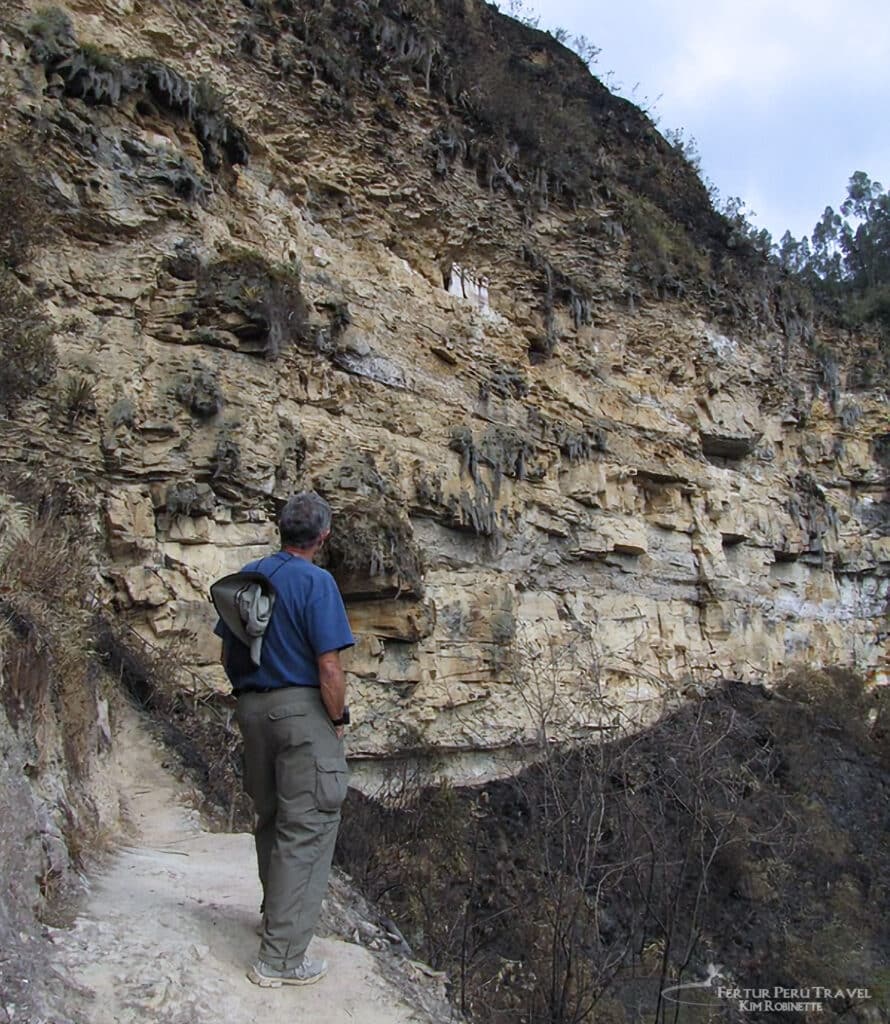
The sarcophagi stand on a narrow ledge of a near-vertical cliff, high above the valley floor, as though suspended between earth and sky. Seen from across the gorge, they appear to watch over the landscape below. Their position helps explain both their preservation and their effect on visitors. They are not tucked away in hidden chambers. They are dramatically displayed.
That visual power seems to have been part of their meaning. These were tombs, but also statements about ancestry, memory, status, and sacred geography.
The archaeological documentation of Karajía
Although local communities had long known of the site, the Karajía sarcophagi entered wider archaeological awareness in the mid-1980s, notably through the work of Peruvian archaeologist Federico Kauffmann Doig. Some accounts emphasize 1984 for the initial documentation, while others highlight 1985 for the expedition that more fully recorded the site.
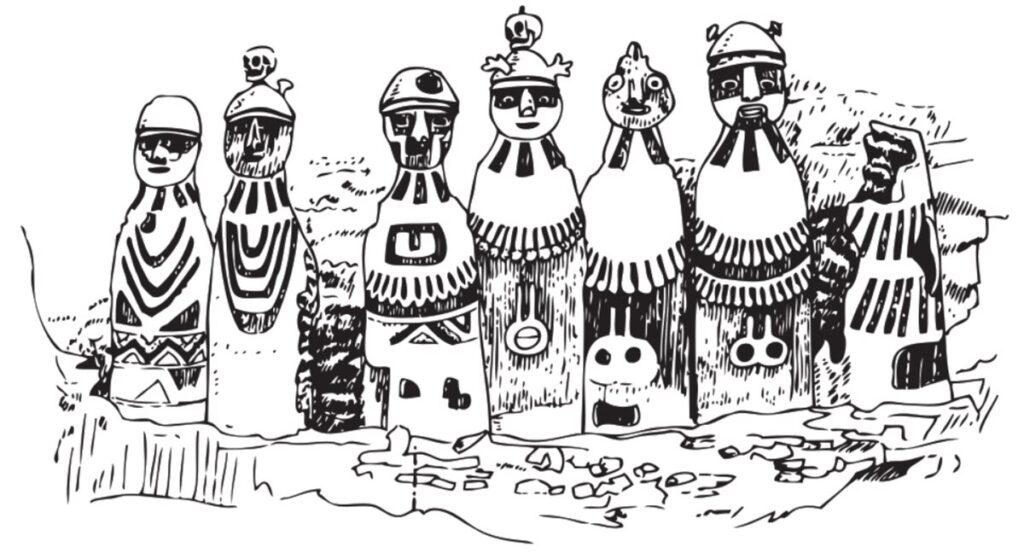
The ledge’s difficult access helps explain the preservation of the group. One figure was destroyed in the 1928 earthquake, but the surviving sarcophagi remained largely intact because of their nearly unreachable position. Subsequent study placed them in the fifteenth century. Radiocarbon dating of associated material suggests a date around AD 1460, shortly before or around the time of the Inka takeover of the region.
That chronology makes the site especially significant. The Karajía tombs likely belong to the final phase of independent Chachapoyas culture.
Why did the Chachapoyas place tombs on cliffs?
It is tempting to assume the cliffside placement served only to protect the dead from looting. Protection may have mattered, but that explanation alone does not go far enough.
Across the Chachapoyas region, burial sites were chosen with notable consistency. They occupy dramatic, elevated positions in the landscape, often overlooking inhabited areas or facing prominent natural features. The dead were placed not to disappear from view, but to remain present.
At Karajía, that logic becomes especially striking. The sarcophagi were positioned where they could endure, dominate the landscape, and continue their symbolic role as ancestral presences above the living world below.
Standing on a cliff roughly 984 feet (300 meters) above the gorge, the figures are not hidden. They are meant to be seen.
Karajía within the wider world of Chachapoyas ruins
The Karajía sarcophagi are one of the signature archaeological attractions of northern Peru, but they are not an isolated phenomenon.
The wider Chachapoyas region contains an exceptional concentration of sites, including Kuélap, Revash, Leymebamba, Laguna de los Cóndores, and numerous lesser-known cliff tombs and settlements. Luya province in particular contains multiple sarcophagus sites beyond Karajía, showing that this was a developed regional funerary tradition rather than a one-off monument.
That is one reason a visit to Karajía Peru is so rewarding. It can be combined with some of the richest and least crowded archaeological travel in the country. For travelers seeking depth rather than checklist tourism, this region offers one of Peru’s most compelling alternatives.
Visiting Karajía today
A visit to the Karajía sarcophagi is usually made as a full-day excursion from Chachapoyas. The route passes through rural communities and mountain scenery before reaching the trailhead and viewpoint facing the cliff.
Visitors do not climb up to the tombs themselves. The sarcophagi are viewed from across the gorge, in keeping with current safety and access practice. Even so, the experience is memorable. With binoculars or a strong zoom lens, the details of the figures come into focus, and the setting does the rest.
Expect a short but sometimes steep walk at moderate altitude. In some cases, mule or horse support may be available from Cruzpata. More broadly, Karajía is often combined with other regional highlights as part of our guided Chachapoyas tours, which make it much easier to appreciate the archaeology, history, and logistics in a coherent itinerary.
Why the Karajia sarcophagi matter
The Karajía sarcophagi matter for more than their visual drama. They represent a rare fusion of funerary ritual, architecture, sacred landscape, and artistic expression. They also remind travelers that some of Peru’s most remarkable archaeological experiences lie well beyond the standard route.
For many visitors, Karajía becomes one of the country’s most memorable sites precisely because it feels so unexpected. There are no large crowds, no monumental stone plazas, and no polished urban setting. Instead, there is distance, silence, and the unsettling presence of the dead on the cliff.
They remain among the most unforgettable Chachapoyas sarcophagi, among the most evocative examples of sky tombs Peru has to offer, and among the strongest reasons to explore the wider landscape of Chachapoyas ruins in northern Peru.
FAQ about the Karajia Sarcophagi
Where are the Karajía sarcophagi located?
The Karajía sarcophagi are located in Luya province in the Amazonas region of northern Peru, near Cruzpata and within excursion range of Chachapoyas.
Who built the Karajía sarcophagi?
They were created by the Chachapoyas, a pre-Hispanic civilization that flourished in the cloud forests of northern Peru before the Inka conquest.
How old are the Karajía sarcophagi?
Radiocarbon dating places them in the fifteenth century, around AD 1460, shortly before or during the Inka takeover of the region.
What is inside the sarcophagi?
Each sarcophagus contained a single individual placed in fetal position, wrapped in textiles and accompanied by funerary offerings such as ceramics, gourds, and woven objects.
Why are they called sky tombs?
“Sky tombs” is a modern descriptive phrase for the cliffside setting of the burials. The tombs stand high on a near-vertical rock face above the surrounding valley.
Can visitors get close to the Karajía sarcophagi?
No. Visitors observe the site from a viewpoint across the gorge rather than climbing to the ledge itself.
How difficult is the visit to Karajía?
The visit is usually done as a full-day excursion from Chachapoyas and includes a short but sometimes steep walk to the viewpoint. Some routes may offer mule or horse support from Cruzpata.
What is the difference between sarcophagi and chullpas?
Chachapoyas sarcophagi are anthropomorphic funerary capsules, generally intended for individual burials, while chullpas are above-ground mausoleums that often contained multiple individuals.
Can Karajía be combined with other Chachapoyas sites?
Yes. Karajía is often paired with Kuélap, Revash, Leymebamba, and other northern Peru highlights in a multi-day itinerary.

Related Posts
Comments (0)