In 1987, archaeologist Walter Alva and his team helped save one of ancient Peru’s greatest…
How to Book a Nazca Lines Flight: Everything You Need to Know Before You Go
The Nazca Lines are a UNESCO World Heritage Site on Peru’s southern coast — more than 800 straight lines, 300 geometric figures, and around 70 animal and plant designs etched across roughly 450 km² (175 square miles) of desert by the Paracas and Nazca cultures between about 400 B.C. and A.D. 500. Most of the figures can only be understood from the air. This guide covers how to book a Nazca Lines flight, which airport to use, what safe operators look like, and what to expect on the day.
Nazca Lines Overflight at a Glance
- Location: Nazca pampa, southern Peru — approx. 450 km (280 miles) south of Lima
- UNESCO status: World Heritage Site (designated 1994)
- Departure airports: Maria Reiche Neuman Airport (Nazca) or Pisco Airport
- Flight duration: 30–35 min over the lines from Nazca; approx. 90–100 min total from Pisco
- Cost: USD 80–120 from Nazca (+ approx. USD 20–25 in local fees); approx. USD 300 from Pisco
- Best time to fly: Early morning, 7:00–9:00 a.m. — calmer air, better visibility, lower sun angle
- Key requirement: Original passport required at check-in
- Not to miss: The monkey, condor, hummingbird, and spider figures
1. Understanding Nazca Lines Flights Before You Book

The hummingbird geoglyph, measuring about 93 meters (305 feet) from beak to tail, is one of the most recognizable figures on the Nazca pampa. Its looping wing lines — drawn in a single continuous stroke without the stylus ever leaving the surface — are a precise feat of ancient draftsmanship that only reveals itself fully from the air.
Photo: Fertur Peru Travel
What Are the Nazca Lines?
Designated a UNESCO World Heritage Site in 1994, the Nazca Lines were created by the Paracas and Nazca cultures between roughly 400 B.C. and A.D. 500. The technique was simple but remarkably precise. Ancient workers removed the dark, oxidized stones covering the desert surface to expose the lighter soil beneath — in many places scraping shallow trenches just several inches deep.
The result was a sharp contrast between the reddish-brown surface stones and the pale desert floor below. In Nazca’s arid climate, with little rain and limited wind erosion, many of these designs have endured for roughly 1,500 to 2,000 years.
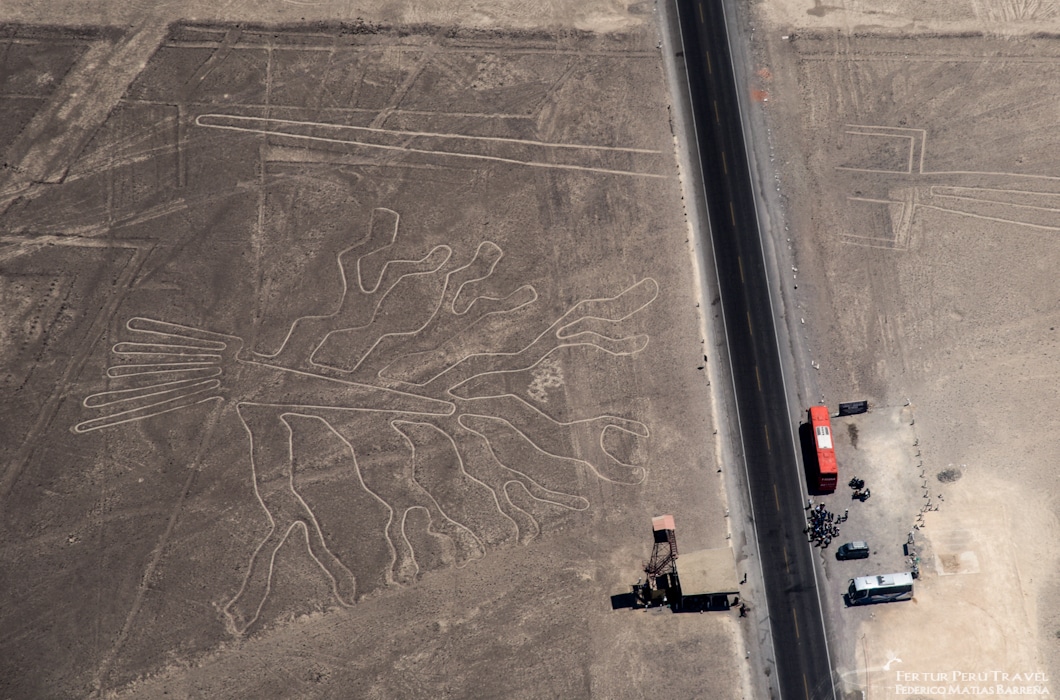
The tree geoglyph stretches across the desert floor beside the Panamericana Sur. At lower right, the roadside observation tower — visible here as a small metal structure beside a cluster of visitors and a tour bus — offers a partial ground-level glimpse of the hands and tree figures. From the air, the full geometry of the tree becomes clear in a way no ground vantage point can match.
Photo: Federico Matias Barreña / Fertur Peru Travel
From the air, the scale becomes clear. The hummingbird extends about 93 meters (305 feet). The condor reaches about 134 meters (440 feet). The spider measures about 47 meters (154 feet). On the ground, many figures appear as simple furrows or lines. From above, they become one of Peru’s most memorable archaeological experiences.
Why Fly Over the Nazca Lines?
A Nazca Lines flight is the best way to understand the site’s scale, design and setting. The roadside observation tower allows visitors to see parts of a few figures, including the tree and hands, but it cannot show the full composition of the geoglyphs or the larger desert landscape.
From the air, you can see how the figures relate to the open pampa, how long straight lines cross the desert, and how carefully the designs were placed. For travelers interested in archaeology, ancient Andean cultures or unusual landscapes, flying over the Nazca Lines is often the highlight of a southern Peru itinerary.

The standard overflight route from Nazca passes over the principal geoglyphs in sequence — among them the monkey, condor, hummingbird, spider, and astronaut. This diagram, displayed at Pisco Airport, shows the relative positions of the main figures across the pampa and the approximate flight path used by commercial operators.
Photo: Fertur Peru Travel / Pisco Airport
Flight Duration and What You’ll See
A standard Nazca Lines flight from Nazca city usually lasts about 30 to 35 minutes. Flights from Pisco are longer — often around 90 to 100 minutes total — because the aircraft must travel farther to reach the geoglyphs. On Pisco flights, roughly 30 to 35 minutes are typically spent over the main Nazca Lines area.
Most aircraft carry 6 to 12 passengers. Smaller Cessna aircraft usually seat about six passengers, while larger Cessna Caravan or Grand Caravan aircraft can carry around 12. Seating is arranged so passengers have window access.
During the flight, the co-pilot generally announces each figure in Spanish and English. Standard routes usually include the monkey, dog, whale, tree, hands, astronaut, hummingbird, condor, and spider. Pilots bank the aircraft to both sides so passengers on each side can see and photograph the figures. These turns are part of the experience, but they can also trigger motion sickness — see Section 6 for preparation steps.
2. Choosing Where to Fly From
Nazca Lines flights depart from Nazca or Pisco. In some seasons, limited options appear from Ica, but availability changes and should always be confirmed directly with the operator.
Flying From Nazca City
The Maria Reiche Neuman Airport in Nazca is the traditional and most common departure point. It is usually the most affordable option, with standard flights commonly priced in the range of USD 80 to USD 120 before local fees.
Flights generally operate from early morning, around 7:00 or 8:00 a.m., through mid-afternoon. Morning departures are strongly recommended because visibility is often better and the air is usually calmer.
Nazca is more than 6 hours south of Lima by road, and bus journeys often take 7 to 8 hours. Many travelers spend the night in Nazca before their flight, especially if they want an early departure. This is also a practical choice for travelers continuing south toward Arequipa or Cusco.
Choose Nazca if you have time in your itinerary, want the most budget-friendly flight option, and prefer maximum scheduling flexibility.
Flying From Pisco
Pisco is a useful option for travelers who want to see the Nazca Lines without traveling all the way south from Lima by road. Pisco is about 220 km (137 miles) south of Lima, and the drive usually takes around 3 hours depending on traffic and road conditions.
Flights from Pisco are longer and more expensive because of the distance to the Nazca Lines, typically around USD 300 per person depending on the aircraft, operator and season.
Pisco is especially convenient for travelers staying in Paracas — the airport is only a short drive away, making it easy to combine a Nazca Lines flight with the Ballestas Islands or Paracas National Reserve.
Choose Pisco if you are short on time, staying in Paracas, or want to avoid the long overland trip to Nazca.
Flying From Ica
Ica has historically appeared as an option for some Nazca Lines flights, especially for travelers staying near Huacachina. However, regular flights from Ica have been extremely limited or suspended by many operators in recent seasons.
For practical planning, expect to fly from Nazca or Pisco. If an operator offers an Ica departure, confirm current availability directly, ask which airport will actually be used, and verify whether transportation to Pisco or Nazca is included.
Which Departure Point Is Best?
Your best departure point depends on your route, time and budget. Fly from Nazca if you are traveling through southern Peru, want the most affordable option, or can spend a night in town. Fly from Pisco if you are based in Lima or Paracas and want a faster day-trip option. Treat Ica as a possible but uncertain seasonal option — not as the basis of your itinerary unless the operator confirms it clearly in writing.
3. How to Choose a Safe and Reliable Flight Operator
Safety should be your first concern when booking a Nazca Lines flight. Sightseeing flights over the desert involve small aircraft, tight turns and changing weather conditions. Choose your operator carefully.
Nazca Lines Flight Safety Standards
After a series of accidents in the late 2000s and early 2010s, Peruvian authorities introduced stricter oversight and inspections for Nazca sightseeing flights. Some airlines and scores of aging aircraft were pulled from service, and safety standards improved.
Established companies such as Air Majoro, AeroNasca and Movil Air are well known in the market and operate modern aircraft.
Ask About Aircraft and Maintenance
Before booking — whether on your own or through a reputable Peru travel agency — don’t be shy. Ask what type of aircraft will operate your flight, how many passengers it carries, and whether the company uses one or two pilots.
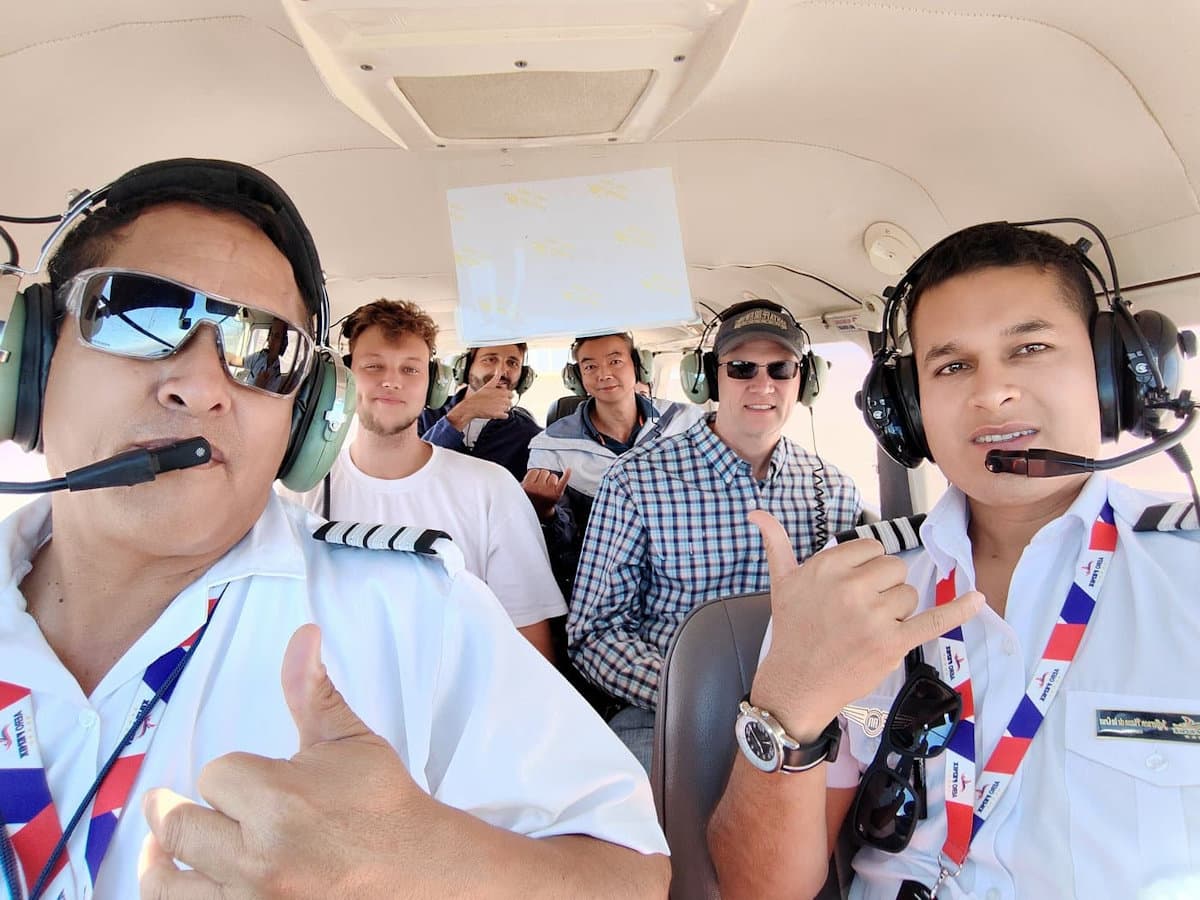
Two pilots, four passengers, headsets fitted, route map mounted to the cockpit partition — ready to go. Many Nazca Lines operators fly with two pilots, which is the preferable standard. Before booking, it is worth asking whether your flight will be crewed by one pilot or two.
Photo: Fertur Peru Travel
Reliable operators should be able to explain their passenger weight policies, weather procedures and check-in requirements. Be extremely cautious with informal street sellers, vague agencies, or offers that seem unusually cheap compared with the market.
4. Protecting the Nazca Lines
The Nazca Lines are protected as a UNESCO World Heritage Site under the formal management of Peru’s Ministry of Culture, which maintains a permanent presence in the region and enforces tightly restricted ground access. Despite that framework, the site’s vast scale makes monitoring difficult — and the geoglyphs themselves are vulnerable in an unforgiving way: a single footprint or body impression left in the ground can remain visible for decades.
Why the Lines Are Fragile
The technique that made the geoglyphs is also what makes them vulnerable. The figures exist because ancient workers carefully removed reddish-brown surface stones to reveal the pale desert floor below — a contrast preserved for nearly two millennia by Nazca’s arid climate and minimal wind erosion. Any disturbance to that surface layer is effectively permanent on a human timescale. There is no restoration process that can undo a footprint or tire track etched into the desert floor.
This is why authorized access to the pampa on foot is tightly restricted, and why even permitted visits require special protective footwear to avoid displacing the surface stones.
Incidents That Tested the Site
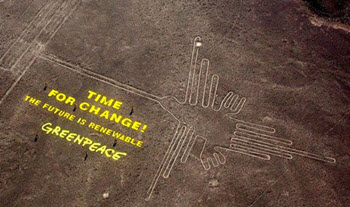
The lines have faced repeated threats in recent decades. In December 2014, Greenpeace activists sneaked onto the pampa at night in hiking boots and sneakers, placing a banner near the hummingbird geoglyph to promote renewable energy at the COP20 climate conference in Lima. The stunt drew international condemnation and resulted in criminal charges against several activists.
The same incident drew scrutiny to a separate case: the Ministry of Culture’s resident archaeologist in Nazca, Mario Olaechea, was suspended and faced criminal charges after escorting a Japanese television crew on an unauthorized ground visit to the hummingbird. The crew had received a permit to film from the air only. Then-Culture Minister Diana Alvarez-Calderón confirmed that entering the protected zone on foot was strictly forbidden under the terms of that permit.
Other threats are less dramatic but much more damaging. Over the years the lines have been endangered by Dakar Rally vehicles, illegal mining operations, land invasions, and construction companies removing desert sand.
An inflection point came in 2015, when words were found etched into the pampa next to the pelican figure near Palpa — discovered by tourists on a routine overflight, a reminder that aerial observation itself plays a role in protection.
Conservation Efforts
Peru passed legislation and placed the Nazca Lines under a formal management system led by the Ministry of Culture and funded with the help of international donations. Protection strengthened over time.
Johny Isla, the Ministry of Culture’s representative in Nazca in 2015, described the challenge plainly: the pampa is simply too large to monitor from the ground alone. Community awareness and aerial observation — including reports from tourists on commercial overflights — has been part of the monitoring strategy.
For visitors, the practical implication is straightforward. Do not accept offers of unauthorized ground access to the geoglyphs, however they are framed. The lines survived nearly two thousand years of desert wind. They are not well suited to foot traffic. Stepping out onto the pampa is considered a serious offense.
5. Step-by-Step: How to Book Your Nazca Lines Flight
Step 1. Decide Where You Want to Fly From
Start by choosing Nazca or Pisco. Nazca is usually cheaper and better if you are continuing through southern Peru. Pisco is more convenient if you are coming from Lima or staying in Paracas.
Step 2. Choose a DGAC-Authorized Operator
Do not book on price alone. Compare operators based on safety record, aircraft, recent reviews, included transfers and cancellation policies. Ask these questions before paying:
- What aircraft type will be used?
- How many passengers does it carry?
- Are there one or two pilots?
- What happens if the flight is delayed or canceled by weather?
- Are airport taxes and local fees included?
Step 3. Book Ahead During Busy Months
From June through August, morning flights can fill up quickly. Booking at least a few days in advance is wise, especially if your itinerary is tight. In quieter months, same-day bookings may be possible, but they come with less control over departure time and less opportunity to evaluate the operator carefully.
Step 4. Compare Prices and Inclusions
Standard Nazca Lines flights from Nazca often cost around USD 80 to USD 120 per person before local fees. Pisco flights are usually much more expensive — often around USD 300 per person — because of the longer flight time. Prices vary by season, aircraft, operator and whether transfers are included.
Before paying, confirm whether the price includes:
- Flight ticket
- Hotel or bus station transfer
- Airport tax
- Nazca Lines tourist ticket
- English-speaking assistance
- Refund or rescheduling policy for weather delays
Step 5. Budget for Local Fees
Airport taxes and Nazca Lines access fees are often charged separately and paid in cash at the airport. From Nazca, budget roughly USD 20 to USD 25 per person for mandatory local fees, though exact amounts can change without notice. From Pisco, local fees may also be charged separately and can be higher. Bring Peruvian soles in cash, even if you paid for the flight by credit card.
Step 6. Review Cancellation Policies
Cancellation policies vary widely. Some operators offer free or partial refunds if you cancel several days in advance; others charge penalties for last-minute changes, and deposits are often non-refundable. Weather cancellations are different — if the operator cancels because of poor conditions, you should be offered a later flight, another date or a refund according to the written terms. Read the policy before booking, especially if you are planning a tight day trip from Lima.
6. What to Prepare Before Your Nazca Lines Flight
Bring Your Original Passport
You must bring your original passport for check-in. A photocopy or photo on your phone may not be accepted. Peruvian citizens and residents should bring their original national identity document or resident card.
Prepare for Motion Sickness
Nazca Lines flights involve repeated banking turns so passengers on both sides can see each figure. Even travelers who rarely get motion sickness can feel queasy. To reduce the risk:
- Take motion sickness medication before the flight if you normally need it.
- Avoid heavy meals before boarding.
- Eat something light, such as crackers or fruit.
- Drink water, but do not overdo it immediately before takeoff.
- Focus on the horizon between figures when possible.
Pack Carefully
Bring sunglasses, sunscreen and a hat for time at the airport, especially if there are delays. A camera or phone with good zoom helps, though photos can be challenging because of the banking turns and aircraft windows. A light jacket is useful for early morning departures, even in the desert. Bring water and some cash in soles for taxes, fees or small purchases.

Inside the cabin during a Nazca Lines overflight — camera ready, route map in hand. Seating is arranged so every passenger has window access, and pilots bank the aircraft to both sides so figures are visible from each seat in turn. A GoPro or small action camera mounted to the window is one way around the challenge of shooting through curved aircraft glass during banking turns.
Photo: Fertur Peru Travel
Choose a Morning Flight
The best time of day for a Nazca Lines flight is early morning, roughly between 7:00 and 9:00 a.m. Air is often calmer, visibility can be better, and the lower sun angle helps the figures stand out against the desert. Afternoon flights may still operate safely, but they can be bumpier because of thermal activity. If you are prone to motion sickness, prioritize a morning departure.
Allow Flexibility for Weather
Nazca is arid year-round, but flights can still be delayed by fog, wind or visibility problems. Winter months on the Peruvian coast can bring morning fog, especially in July and August. If the Nazca Lines flight is important to your trip, avoid scheduling it immediately before a long bus connection or same-day international flight.
Check Weight Restrictions for a Nazca Lines Flight
Many Nazca flight operators apply individual passenger weight limits, often around 90 to 95 kg (198 to 209 pounds). The practice is not new. It was implemented in 2011. If you exceed the operator’s limit, you may be asked to purchase an additional seat. All passengers are weighed at check-in so the crew can balance the aircraft properly — this is a normal aviation safety procedure.
7. Quick Summary: Choosing Your Flight
A Nazca Lines flight is one of Peru’s most unusual travel experiences and one that rewards careful planning. Fly from Nazca for the more affordable and flexible option. Fly from Pisco if you are short on time or staying in Paracas. Treat Ica as a limited, seasonal possibility only if confirmed directly by the operator.
Book with a reputable, DGAC-authorized airline. Ask about aircraft, pilots, weather policies, local fees and cancellation terms before you pay. Bring your original passport, prepare for motion sickness, and aim for an early morning departure. The Nazca Lines have endured for nearly two millennia in the desert — seeing them from the air is the only way to grasp their full scale and precision.
FAQs About the Nazca Lines Flight
Is flying over the Nazca Lines worth it?
An overflight is the only way to understand the full scale, geometry and placement of the Nazca Lines — the roadside observation tower shows only fragments of a few figures, and no ground vantage point reveals the complete composition of any design. For travelers with an interest in archaeology, ancient cultures or unusual desert landscapes, it is consistently one of the most memorable experiences in a southern Peru itinerary.
How much does a Nazca Lines flight cost?
A standard Nazca Lines flight from Nazca usually costs around USD 80 to USD 120 per person before local fees. Travelers should also budget roughly USD 20 to USD 25 in cash for airport and Nazca Lines access fees, though these amounts can change. Flights from Pisco are longer and typically cost around USD 300 per person.
How much time do I need for a Nazca Lines trip?
For a flight from Nazca, plan on at least one night in town — most travelers arrive the evening before to secure an early morning departure, when conditions are best. If you are continuing south toward Arequipa or Cusco, a second night gives more flexibility. The overflight itself runs about 30 to 35 minutes over the pampa. Travelers flying from Pisco can do it as a day trip from Lima or Paracas: the drive south takes around 3 hours, and the total flight time including transit to the lines is roughly 90 to 100 minutes. Budget a full day for the Pisco option to allow for check-in, potential weather delays, and the return drive.
Which airport is best for a Nazca Lines flight?
Nazca is usually the best option for travelers who want the most affordable flight and have time to travel south from Lima. Pisco is better for travelers based in Lima or Paracas who want a shorter road journey. Ica flights are limited or seasonal and should be confirmed directly before planning around them.
What is the best time of day to fly over the Nazca Lines?
Morning flights, especially between 7:00 and 9:00 a.m., are usually best. The air is often calmer, visibility can be better, and the lower sun angle helps the lines stand out against the desert. Afternoon flights can be bumpier because of desert heat and thermal activity, which also increases the risk of motion sickness.
Can you see the Nazca Lines without flying?
You can see a small number of figures from the ground at the roadside observation tower on the Panamericana Sur highway, including partial views of the tree and hands geoglyphs. However, the tower gives only a fragmented ground-level view and cannot show the full composition of any figure or the broader layout of the pampa. For anyone who has traveled to Nazca, an overflight is the most meaningful way to experience the site.
Are the Nazca Lines protected?
The Nazca Lines are protected as a UNESCO World Heritage Site and under Peruvian law by the Ministry of Culture, which maintains a permanent presence in the region. Authorized access to the pampa on foot is tightly restricted, and any ground visit requires special protective footwear to avoid displacing the surface stones. Conservation efforts have intensified following high-profile incidents — including the Greenpeace banner stunt in 2014 and an unauthorized ground visit by a Japanese television crew that led to criminal charges against the Ministry’s own resident archaeologist. Despite these protections, the site’s vast scale makes monitoring difficult, and threats from illegal mining, land invasion, and unauthorized visitors remain ongoing. Aerial observation — including by tourists on commercial overflights — has been part of the monitoring strategy. Do not accept offers of unauthorized ground access to the geoglyphs, however they are framed.
What should I bring for a Nazca Lines flight?
Bring your original passport, sunglasses, sunscreen, water, a light jacket and a camera or phone with good zoom. If you are prone to motion sickness, take medication before the flight and avoid heavy meals. Bring Peruvian soles in cash for airport taxes and local fees, even if you paid for the flight by credit card.
Who created the Nazca Lines and why?
The Nazca Lines were created by the Paracas and Nazca cultures between roughly 400 B.C. and A.D. 500. The technique involved removing dark, oxidized surface stones to expose the lighter soil beneath, creating a lasting contrast visible from above. The purpose of the lines remains debated among researchers — proposed explanations include astronomical calendars, ritual pathways connected to water and fertility ceremonies, and offerings to Andean deities. No single theory has been universally accepted, which is part of what makes the site genuinely compelling rather than merely photogenic.

Related Posts
Comments (0)