Peru Belmond Hotels will keep operating the Machu Picchu Sanctuary Lodge until March 2028 after…
Lord of Sipán Museum: Rescue, Looting and Law
In 1987, archaeologist Walter Alva and his team helped save one of ancient Peru’s greatest royal tombs from looters. Nearly forty years later, the Lord of Sipán museum built to protect that legacy has received another, quieter form of protection: a definitive property registration title.
Sunarp, Peru’s national public records office (the Superintendencia Nacional de los Registros Públicos — roughly the equivalent of a land registry or county recorder’s office), delivered the document that rectifies the area, boundaries and perimeter measurements of the land occupied by the Royal Tombs of Sipán Museum in Lambayeque.
A Historic Title for One of Peru’s Great Museums
In a ceremony in Lambayeque, Sunarp handed the Regional Government of Lambayeque the definitive registration title where the Royal Tombs of Sipán Museum stands. In plain terms, the official land record is now formally corrected and updated — its area, boundaries and perimeter measurements now match reality, recorded under a single registry entry.
Among those present was Walter Alva, the archaeologist who led the rescue excavation that brought the Lord of Sipán to world attention. He went on to champion the museum’s creation and is president of the Lambayeque Regional Tourism, Culture and Identity Commission.
Sunarp described the inscription as a “title with historical value” — one of the more emblematic entries in a public registry that rarely makes cultural news.
The regularization was the product of long coordination between Sunarp and other public entities. That timeline — decades between the museum’s inauguration and the completion of its property record — is the quiet heart of this story.
The 1987 Rescue That Changed Peruvian Archaeology
The Sipán story began not with archaeologists but with looters. In early 1987, huaqueros tunneled into a Moche platform mound at Huaca Rajada, near the village of Sipán outside Chiclayo, and began spiriting spectacular gold objects into the black market. Alva intervened, and the rescue excavation that followed revealed the intact tomb of a Moche ruler now known as the Lord of Sipán.
Sunarp’s own announcement recalls why the find revolutionized American archaeology: the principal royal tomb excavated by Alva’s team was found intact, with its funerary context preserved, even though looting at Huaca Rajada had already triggered the emergency response. Its offerings of gold, silver and precious stones rank among the most important finds of the 20th century.
That intact context is what made Sipán extraordinary. Unlike many elite Moche burials, stripped long ago of their objects and their meaning, Sipán could be studied scientifically. The position of the body, the retainers buried alongside him, the offerings and the ritual arrangement of the tomb helped scholars understand Moche power, religion and political hierarchy in a way objects trafficked in the antiquities market never could.
It remains one of the richest unlooted royal burials scientifically excavated in the Americas.
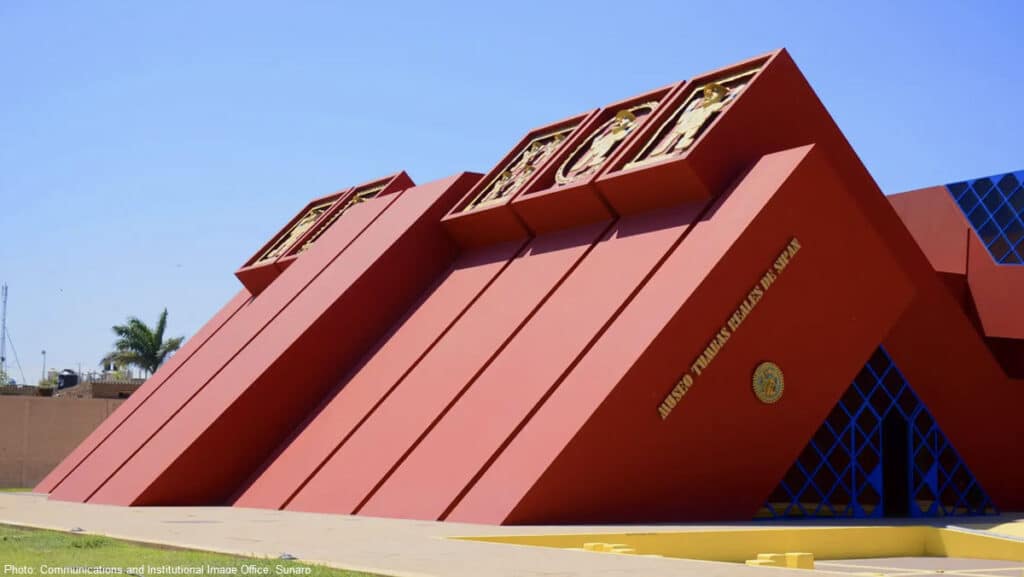
The finds also stayed in northern Peru. The Royal Tombs of Sipán Museum opened in Lambayeque in 2002, purpose-built to house the tomb assemblages. Its architecture evokes a Moche ceremonial pyramid. Rather than moving the treasures permanently to Lima, Peru anchored a world-class museum in the region where the discovery took place.
The Huaca Rajada–Sipán site museum, inaugurated in January 2009, later added interpretation at the archaeological complex itself.
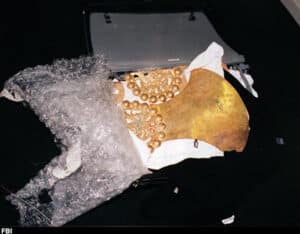
Sipán became a landmark in the fight against antiquities trafficking, too. Looted pieces from the 1987 episode triggered international investigations, including the recovery of a Moche gold backflap in an FBI sting in Philadelphia. That case, in turn, helped strengthen the legal framework behind U.S.–Peru cooperation restricting imports of Peruvian archaeological material.
Why Lord of Sipán Legal Formalization Matters
The Sipán story shows both the strength and weakness of Peru’s heritage system. In 1987, archaeologists and authorities moved quickly to save an intact royal tomb from looting. But the legal and administrative work around the museum property has taken far longer. Sunarp’s new registration title is therefore more than paperwork. It marks the completion of a long property-regularization process behind one of Peru’s most important archaeological museums.
Clear, definitive land records matter in unglamorous but practical ways. They give regional authorities firmer footing for security, maintenance and insurance. And crucially for what comes next, public investment projects move faster and more safely when the land beneath them is legally unambiguous.
A New Phase for the Royal Tombs of Sipán Museum
The timing is no accident. The museum is slated for a major improvement and expansion project valued at S/ 89,524,707.10 — roughly US$24 million — encompassing new exhibition spaces, conservation and research facilities, workshops, a library, administrative areas, visitor services and public spaces.
The definitive title clears the way for the museum’s next chapter, nearly a quarter century after it first opened its doors.
Sipán as a Success Story — With Caveats
Sipán is not a simple triumphal story, and that is part of what makes it instructive. The 1987 rescue happened because looting had already begun; the response was reactive, not preventive. The confrontation around the site was violent, and local resentment took years to heal. Residents of the village of Sipán long felt that tourism’s benefits were passing them by — one reason an on-site museum was eventually built. And the adobe huacas still face conservation challenges in a region battered by El Niño rains.
Visiting Sipán and Chiclayo Today
For travelers, none of this administrative history changes the essentials — it simply adds a layer to one of the most rewarding archaeological circuits in Peru.
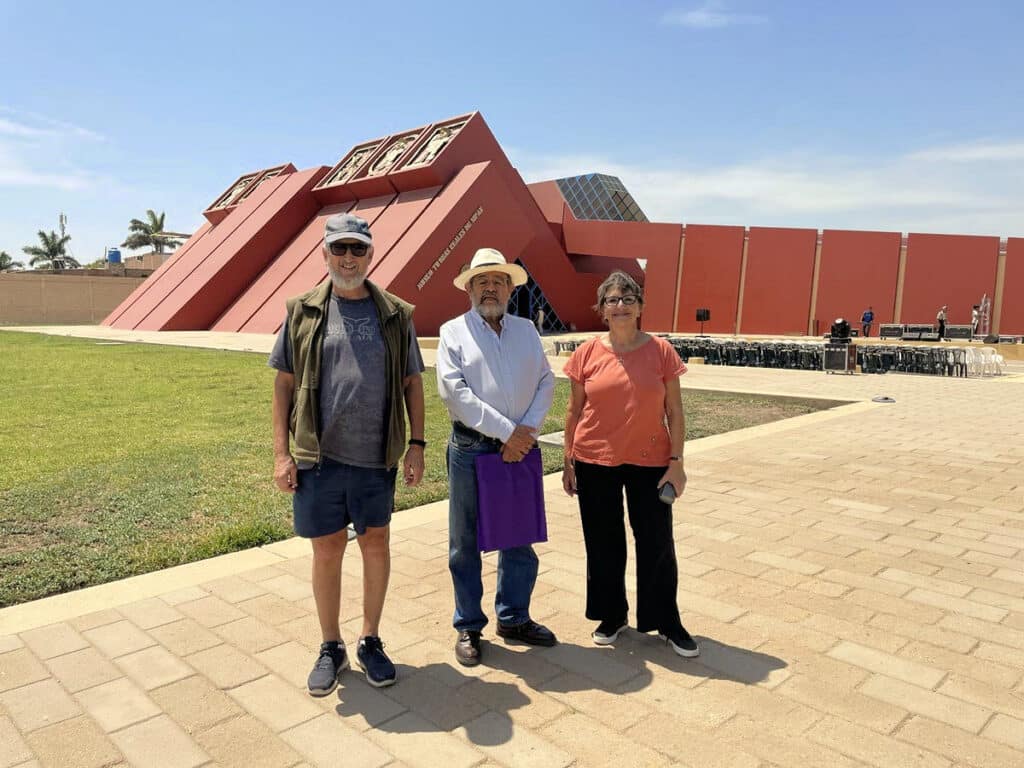
The Royal Tombs of Sipán Museum (Museo Tumbas Reales de Sipán) is in the town of Lambayeque, about 20 minutes north of Chiclayo. It is open Tuesday through Sunday, 9 a.m. to 5 p.m. The museum displays the Lord of Sipán’s tomb assemblage — the gold, silver and turquoise ornaments, the ceremonial regalia, and the reconstructed burial itself — in a dramatic descending layout that mirrors the excavation.
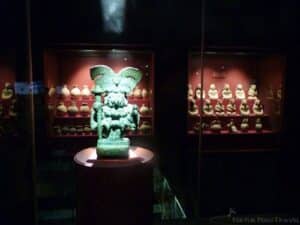
The Huaca Rajada–Sipán site museum sits at the discovery site near the town of Zaña, southeast of Chiclayo. Visiting both in one day is entirely feasible and gives you the full arc: the place where the tomb was found, and the museum where its treasures now reside.
Chiclayo makes an easy base, with connections to the rest of the Ruta Moche — Túcume’s pyramids, the Sicán National Museum in Ferreñafe, and the Brüning Museum in Lambayeque.
Lord of Sipán Frequently Asked Questions
Where is the Royal Tombs of Sipán Museum?
The Royal Tombs of Sipán Museum (Museo Tumbas Reales de Sipán) is in the town of Lambayeque, on Peru’s northern coast, at Av. Juan Pablo Vizcardo y Guzmán 895. It sits about 11 km (7 miles) north of Chiclayo — roughly 20 minutes by taxi or colectivo. Chiclayo is the regional hub and has an airport with direct flights from Lima.
How much does it cost, and what are the hours?
General admission to the Royal Tombs of Sipán Museum is S/ 10, with a reduced S/ 4 rate for university and technical-institute students; children aged 3 to 17 enter free. The museum is open Tuesday through Sunday, 9 a.m. to 5 p.m., and occasionally opens on Mondays that fall on national holidays. Prices are set by Peru’s Ministry of Culture and can change, so it is worth confirming before you go.
Can I visit both the museum and the Huaca Rajada site in one day?
Yes — seeing both in a single day is straightforward. The Royal Tombs of Sipán Museum in Lambayeque holds the tomb treasures, while the Huaca Rajada–Sipán site museum, about 30 km (19 miles) southeast of Chiclayo near the village of Sipán, stands where the tomb was found in 1987. Together they give you the full arc: the discovery site and the treasures themselves. Basing yourself in Chiclayo keeps the logistics simple.
Is the Lord of Sipán museum worth visiting?
The Royal Tombs of Sipán Museum ranks among the finest archaeological museums in the Americas, purpose-built to display one of the richest unlooted royal tombs ever scientifically excavated on the continent. Its descending layout walks visitors down through the burial the way Walter Alva’s team uncovered it in 1987, past the gold, silver, and turquoise regalia of the Moche ruler. For anyone drawn to pre-Columbian history it is a highlight of northern Peru, and a strong reason to travel beyond the usual Cusco–Machu Picchu circuit.
Ready to see the Lord of Sipán for yourself? Explore our Chiclayo tours or contact Fertur Peru Travel to build the northern Peru itinerary that fits your trip.

Related Posts

Comments (0)