
In 1987, archaeologist Walter Alva and his team helped save one of ancient Peru’s greatest…

Things to Do in Arequipa: Your Practical White City Travel Guide for 2026
Finding things to do in Arequipa means getting to know a city where one of the world’s deepest canyons drops about 3,270 meters (10,700 ft), colonial architecture gleams in white volcanic stone, and El Misti rises to 5,822 meters (19,101 ft) above the rooftops. Few destinations in Peru combine history, food, and adventure this completely. This guide covers the essential places to visit in Arequipa — from the UNESCO-listed historic center and Santa Catalina Monastery to day trips into Colca Canyon — along with practical tips for navigating the White City.
Arequipa at a Glance
- Location: Southern Peru, about 1,000 km (620 miles) southeast of Lima
- Altitude: 2,335 meters (7,661 ft) — noticeably gentler than Cusco’s 3,399 meters (11,152 ft)
- Best season: April–November for reliably dry, sunny days; December–March brings rain, especially around Colca Canyon
- Recommended stay: 3–4 days (2 for the city, 1–2 for Colca Canyon)
- Getting there: ~1.5-hour flight from Lima or ~1-hour flight from Cusco; overland buses take roughly 16 and 10 hours respectively
- Key tickets: Santa Catalina Monastery ~S/45; Colca tourist ticket S/70 for foreign visitors
- Not to miss: Juanita the Ice Maiden at the Museum of Andean Sanctuaries; a lunch-only picantería meal
1. Essential Things to Do in Arequipa’s Historic Center
The Historic Center of Arequipa — a UNESCO World Heritage Site since 2000 — is built largely of white sillar, the volcanic stone that gave the city its nickname. Its architecture tells a story of earthquakes, reconstruction, and endurance.

Plaza de Armas and the Cathedral Basilica
The Basilica Cathedral, begun in the 1540s and rebuilt repeatedly after earthquakes and an 1844 fire, commands the entire north side of Arequipa’s palm-shaded Plaza de Armas. The current building dates largely to a reconstruction completed around 1850.

The facade is a forest of Corinthian columns with three main doorways, flanked by two Renaissance-style towers — one holding an English clock from 1842.
Look closely and you will see a ragged bullet hole in the clock face, left during the Arequipa uprising of June 1950, when students and civilians confronted the military regime of Manuel A. Odría.
Inside, three naves hold treasures that make this one of South America’s most important colonial cathedrals: a Belgian organ ranked among the continent’s largest, a neo‑Gothic French oak pulpit carved in Lille in the 1870s by the French sculptor Charles Buisine‑Rigot.
(Note: The archdiocese of Arequipa maintains a dress code that prohibits visitors from entering the Cathedral wearing hats, or dressed in short pants.)
Santa Catalina Monastery
Founded in 1579 by the wealthy widow Doña María de Guzmán, Santa Catalina is a 20,000-square-meter (215,000 sq ft) walled “city within a city” that remained closed to outsiders for nearly 400 years — it opened to visitors only in 1970.

At its peak in the 17th and 18th centuries the monastery housed 175 nuns. Families paid dowries equivalent to roughly $150,000 in today’s money to secure places for daughters who, once inside, never left — though wealthier nuns lived in private mansions with kitchens, living rooms, and quarters for servants. Today you wander narrow streets painted in deep reds and blues, past small plazas with fountains, a communal laundry, gardens, and restored houses. Stone steps in one courtyard lead to a rooftop with panoramic views of the surrounding ice-capped volcanos. Twenty nuns still live in a private section.

Adult entry is S/45, with reduced prices for seniors, children and students. Guided tours in seven languages cost extra. The monastery is generally open daily from about 9:00 AM to 5:00 PM, with late-afternoon last entry and closures on some major holidays.
San Lázaro Neighborhood
San Lázaro predates Arequipa’s official 1540 founding and is the city’s oldest neighborhood — a free-to-wander cluster of black cobblestone alleys and white sillar walls about 850 meters (just over half a mile) from the Plaza de Armas, a 15-minute walk along the Chili River.
The alleys carry distinctive names — Violín, Cristales, Desaguadero, Ripacha, Calienes, Combate Naval, Bayonetas. Bayoneta Alley squeezes to shoulder width; Cristales runs without sidewalks. A small chapel here is among the oldest in Arequipa, and Camporredondo square — now called Matorral — once served as a market. Local bakeries sell Ripacha bread, a traditional wheat loaf. The National Institute of Culture declared San Lázaro a Monumental Urban Environment in 1972, and it falls within the UNESCO-listed Historic Center.
2. Museums and Cultural Places to Visit in Arequipa
Museum of Andean Sanctuaries (Juanita, the Ice Maiden)
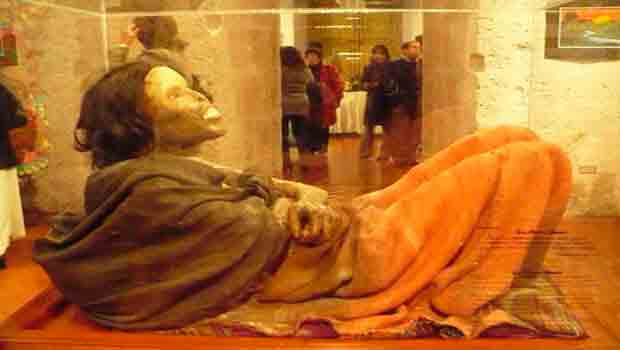
The Museum of Andean Sanctuaries, 200 meters (650 ft) from the Plaza de Armas at Calle La Merced 110, houses Juanita, the Ice Maiden — an Inca girl sacrificed around 1450 and found frozen on Ampato Volcano in 1995. She is on display May through December.
High-altitude archaeologist Johan Reinhard discovered Juanita on September 8, 1995, at more than 6,000 meters (19,685 ft) on Ampato’s summit, after a volcanic eruption melted the snowcap covering her burial site and her body tumbled down the slope — which is why one side is better preserved than the other. She was 13 or 14 years old, about 1.58 meters (5 ft 2 in) tall, and was sacrificed during the reign of the Inca Pachacutec as an offering to the mountain gods. Time magazine named her one of the world’s top ten discoveries of 1995, and National Geographic featured her in its June 1996 issue.
The museum, opened in 1997, has five permanent rooms displaying the complete Capac Cocha ritual collection — textiles, ceramics, precious-metal offerings, and the wooden keros used in high-altitude ceremonies — plus remains of five other mummies found on Misti in 1998. From January through April, while Juanita undergoes conservation, the museum displays Sarita, another Inca girl, found on Sara Sara Volcano in Ayacucho. Visits include a short introductory video filmed on Ampato itself. Hours are usually Monday–Saturday 9:00 AM–6:00 PM and Sunday 9:00 AM–2:00 PM.
Claustros de la Compañía
Half a block from the Plaza de Armas at General Morán and Álvarez Thomas, the Claustros de la Compañía are the cloisters of Arequipa’s colonial Jesuit complex — free to enter, usually 9:00 AM–6:00 PM, and now home to artisan shops and quiet patio cafes.
Construction began in 1578 to plans by architect Gaspar Báez; the great earthquake of November 13, 1582 destroyed much of it, and reconstruction under Father Diego Felipe began in 1590, with the complex finally inaugurated in 1698. The Jesuits ran Santiago College here from 1583 until their expulsion in 1767. The baroque mestizo carving on the sillar is the draw: Christian figures interwoven with Andean symbols — coca leaves, local flowers and animals, sirens, geometric patterns.
A stone stairway in the first of the two large cloistered patios leads to rooftop viewing area offering panoramic views of the surrounding countryside beyond the city. The second patio, with its aligned arches and carved columns, is a photographers’ favorite.

Casa del Moral
Casa del Moral, built around 1730, is one of Peru’s best-preserved examples of Andean Baroque civil architecture. Entry costs S/5 (about $1.50–2.00 USD), and stairs lead to a rooftop with views over the city and mountains.
The mansion takes its name from the century-old mulberry tree (moral) in its main courtyard. Its carved stone entrance archway depicts castles, crests, and animals around the coat of arms of Manuel Santos de San Pedro. Inside are period furniture from the Viceroyalty and Republican eras, paintings of the Escuela Cusqueña (Cusco School), and a library of more than 3,000 volumes of Hispanic literature. The house belongs to Fundación BCP and operates as a museum of Arequipa’s colonial elite.
3. Markets and Local Experiences
San Camilo Market
San Camilo, the city’s largest market, opened in 1881 about 700 meters (under half a mile) from the Historic Center, and is the best single stop for understanding Arequipeño cooking — the rocoto and panca chilies and corn that underpin dishes like adobo, rocoto relleno, and solterito.
The market stands on grounds once occupied by a Camillian church, and sculptures of San Camilo, San Pedro, and the Lord of Forgiveness still watch over the halls. Its distinctive metal structure, inaugurated in 1938, is commonly attributed to designs by Gustave Eiffel, though the records are debated. It holds recognition as a Monumental Historical Heritage site of Arequipa and Cultural Patrimony of the Nation.
The aisles overflow with native potatoes, corn, aromatic herbs, dried chilies, and valley fruit; whole sections are devoted to fresh juice, fish, meat, and medicinal herbs. Food vendors cook on the spot — stuffed rocotos, ceviche, traditional breads — and during Holy Week the market fills with hearty wheat loaves and pan de tres puntas.
Mundo Alpaca
Mundo Alpaca, at 101 Juan de la Torre Avenue in San Lázaro, is a free textile center — typically open daily from about 8:30 AM until early evening — where you can meet alpacas and llamas up close and watch weavers work pre-Inca backstrap looms.
Expert classifiers demonstrate ancestral fiber-sorting techniques passed down since pre-Hispanic times, and weavers from Cusco communities give live loom exhibitions. The site houses one of Peru’s very few textile machinery museums, with early-20th-century machines showing the industrial process from fiber to finished garment, and the Amano-Michell Museum — Peru’s first pre-Columbian textile museum — with pieces from the Paracas, Nasca, Wari, Chancay, and Siguas cultures. The Siguas pieces stand out as native to the Arequipa region. The tour ends at the Sol Alpaca boutique; vicuña fiber, the finest in the world, must still be prepared by hand to remove bristle from the fleece.
4. Best Viewpoints in Arequipa
Arequipa sits at 2,335 meters (7,661 ft), ringed by three volcanoes — Chachani, Misti and Pichu Pichu — and the right vantage point frames the white sillar city against all three.
Mirador de Yanahuara

The Yanahuara viewpoint, 2 km (1.2 miles) from the Plaza de Armas, is free to visit and is Arequipa’s most photographed lookout: ten symmetrical sillar arches framing Chachani, Misti, and Pichu Pichu, with the Chili River and green fields below.

Built in the 19th century in neoclassical style, each arch carries bas-relief inscriptions of verses from Arequipa poets and thinkers — Alberto Hidalgo, Alberto Guillén, Percy Gibson, Francisco Mostajo. The surrounding Yanahuara neighborhood, named for the pre-Inca culture that lived along the Santo Tomás river, has narrow Andalusian-style streets, with the colonial San Juan Bautista church beside the viewpoint. Police surveillance operates through the day.
Carmen Alto Viewpoint
Carmen Alto, about 6 km (3.7 miles) from the plaza — roughly 15 minutes from the Historic Center — overlooks the Chilina valley, where pre-Inca terraces considered important infrastructure works in pre-Columbian America are still farmed today. Beyond that bucolic foreground are unencumbered vistas of all three volcanos. Entry is S/5 for adults and S/3 for children, and the viewpoint closes at 5:00 PM, so don’t count on sunset.

The hill has a remarkable scientific pedigree: from 1890 to 1927 it hosted Harvard’s Boyden Station, the observatory whose photographic plates of the southern sky underpinned Henrietta Swan Leavitt’s period–luminosity law — the yardstick later used to measure distances to other galaxies — and where Saturn’s moon Phoebe was first photographed. An asteroid discovered here was named (737) Arequipa.
Rooftop Sunset Spots in the City Center
Sunset Rooftop Bar at Le Foyer runs pisco sour workshops — taste several piscos, then mix your own — under fairy-lit pergolas with panoramic views. Waya Lookout, on the west side of the Plaza de Armas, requires passing through a first-floor restaurant and climbing to the roof; arrive an hour before sunset for an unobstructed table facing the square, the cathedral, and Misti. Santa Catalina Monastery’s own rooftop offers volcano views from inside the colonial complex.
5. Day Trips and Adventures from Arequipa
Colca Canyon

Colca Canyon, one of the deepest in the world at about 3,270 meters (10,700 ft), is Arequipa’s signature day trip. Full-day group tours start around $49 USD per person, plus a tourist ticket of S/70 for foreign nationals (S/40 Latin Americans, S/20 Peruvians with government issued ID). Tours depart around 3:00 AM and return around 5:30 PM — a 14–16 hour day.
The payoff is Cruz del Cóndor, where Andean condors ride the morning thermals at eye level. The route also crosses the Mirador de los Andes at 4,910 meters (16,109 ft), stops for breakfast in Chivay, and passes the villages of Yanque and Maca, the pre-Inca terraces at Antahuilque, and wild vicuñas in the Salinas y Aguada Blanca reserve, with optional hot springs at Yanque. Multi-day versions add overnight stays in the canyon villages and time the condor viewpoint for when the birds are actually flying; the full-day format works for travelers on a tight schedule, but it doesn’t allow much beyond the highlights.
Want to see the canyon without the 3:00 AM wake-up call? Fertur’s 4-day, 3-night Colca Canyon tour covers the valley at a humane pace, with village overnights and condor viewing timed for the morning thermals.
Ruta del Sillar (Sillar Route)
The Sillar Route, 30 minutes outside the city, runs about 2 km (1.2 miles) through the quarries where Arequipa’s white building stone is still cut by hand. Group Tours cost 50–80 soles (around $15–20 USD) and last 3–4 hours.

The Sillar Route follows the historic path once used to transport the pale volcanic sillar stone that built Arequipa’s colonial monuments, cutting through wind-carved canyons of the same creamy white rock — a surreal, otherworldly landscape that feels entirely removed from the city just kilometers away.

Highlights are the Añashuayco quarry, with myriad sculptures and a cathedral facade carved directly into the cliff face (entry S/.10) , and the Quebrada de Culebrillas (S/. 8 entry), a narrow wind- and water-carved canyon with Wari-culture petroglyphs.

For travelers seeking an active half-day excursion beyond the standard Arequipa itinerary, the Sillar Route offers canyon hiking, extraordinary rock formations, and an intimate connection with both the natural geology and living cultural traditions of the region. At about 2,300 meters (7,546 ft) — about the same elevation as the city — this is the day trip least likely to trigger altitude symptoms. Bring sun block and insect repellent!
Molino de Sabandía
The Molino de Sabandía is a working colonial water mill about 8 km (5 miles) southeast of the Plaza de Armas, roughly 20–30 minutes by car, set in green countryside in the Sabandía district. Entry is S/10, and it is generally open daily from about 9:00 AM to 5:00 PM. It makes an easy half-day trip, on its own or paired with the nearby Yanahuara and Carmen Alto viewpoints, and it sits at city elevation, so altitude is not a concern.

Built of white sillar in 1621 — most sources credit the master stonemason Francisco Flores, though a minority date the structure to 1785 — the mill ground the district’s wheat for centuries before falling into ruin. It was rescued and restored in 1973 by architect Luis Felipe Calle, and its water-powered millstones turn again today, fed by a cascade from the nearby springs. The three-hectare grounds hold gardens, hundred-year-old trees, and grazing llamas, alpacas, and vicuñas, and the bright white walls against the green fields make it one of the most photogenic spots around Arequipa. The mill is recognized as Cultural Heritage of the Nation.
Climbing Misti or Chachani
El Misti (5,822 meters / 19,101 ft) is a two-day climb with overnight camping at 4,500–4,700 meters (14,764–15,420 ft) and a summit push starting around 1:00 AM. Guided group tours run roughly $110–180 USD per person, including guide, camping equipment, and meals; private/premium services can exceed $250–450 USD.
Chachani (6,075 meters / 19,931 ft) has a reputation as one of the world’s most accessible 6,000-meter peaks: two-day ascents start from trailheads around 5,000 meters (16,404 ft), with summit pushes of 6 to 7.5 hours. Neither mountain is technical, but both demand genuine fitness and real acclimatization — spend several days to a week at 3,500–4,500 meters (11,483–14,764 ft) before attempting either.
Salinas and Aguada Blanca National Reserve
This 366,936-hectare (906,722-acre) reserve, created in 1979, protects vicuña populations and high-altitude wetlands between roughly 3,500 and 6,075 meters (11,483–19,931 ft). Day tours take in Laguna Salinas, where flamingos gather; Pampa Cañahuas for vicuña viewing; and the Patapampa overlook for volcano panoramas. Most travelers cross the reserve on Colca Canyon transfers, but dedicated tours from Arequipa allow a fuller look at the landscape.
6. Where to Eat in Arequipa: Picanterías and Contemporary Cuisine
Arequipa is widely regarded as one of Peru’s great regional food cities, and its identity centers on the picantería — a lunch-only restaurant tradition that grew out of the chicherías where locals once gathered to drink chicha de jora, the fermented-maize beverage. Expect wood-fired stoves, communal tables, generous portions, and a different soup assigned to each day of the week. The signature dishes are rocoto relleno (stuffed hot peppers — delicious, but very spicy), chupe de camarones (river-prawn chowder), and Sunday adobo (marinated pork stew), built on the region’s river shrimp, chilies, cheeses, and corn.

Traditional Picanterías
La Capitana (Calle Los Arces 209, Cayma) and El Pato (Melgar 306, near Santa Teresa church) draw local crowds; La Nueva Palomino (Leoncio Prado 122, Yanahuara) is the most popular with visitors. All three serve lunch only — arrive hungry and plan to linger.
The Guardians of the Recipe
Chef Kent Zúñiga of Kao Restaurant describes Arequipa’s cuisine as the product of its volcanic soils, fertile valleys and close relationship between farmers and cooks. Local onions, garlic, river shrimp, cheeses, wines and piscos give the region’s food its distinctive character.
At the center of that tradition are the picanteras — the women who run Arequipa’s traditional picanterías and preserve regional recipes, cooking methods and daily culinary customs passed down through generations. Contemporary chefs, Zúñiga argues, can innovate while remaining grounded in that heritage.
“Many of our memories of Arequipa are tied to what we have eaten — a chupe, a rocoto relleno or a good pastel de papa,” Zúñiga says. “The picanteras are the guardians of recipes passed down from generation to generation.”
Contemporary Arequipeño Kitchens
Two restaurants show what that grounded innovation looks like in practice.
Chicha por Gastón Acurio (Calle Santa Catalina 210, Interior 105, Cercado) is the Arequipa outpost of Peru’s best-known chef, reworking regional classics — rocoto relleno, chupes, river shrimp — with the polish of a modern kitchen.

Kao (Calle San Francisco 217), from chef Kent Zúñiga, builds its menu on the same volcanic-valley ingredients the picanteras use, treating the traditional repertoire as a foundation rather than a museum piece.

Coffee and Craft Beer
For coffee, Kafi Wasi (Calle Pte. Bolognesi 216, near the plaza) lets you choose your preparation method — chemex, French press, mocha — and Palacios Coffee (Lima 201) roasts on-site. Chelawasi Public House serves Peruvian craft beer flights, and Kaffeehaus (Melgar 117) pairs German-inspired dishes with a garden courtyard.
7. Where to Stay in Arequipa and Colca Canyon
The Centro Histórico puts you steps from everything in sections 1–4, with the trade-off of church bells and audible weekend nightlife revelry; the Selva Alegre and Yanahuara areas offer gardens, volcano views, and quieter nights within 15–25 minutes of the Plaza de Armas. If you’re doing Colca Canyon over two or more days, you’ll also want a night or two in the valley itself. These are the properties Fertur books most often — see the full list of Arequipa hotels.
In the City
Best for first-time visitors: Casa Andina Select Arequipa Plaza sits directly on the Plaza de Armas, with cathedral views from its rooftop terrace. Its 58 rooms put the Museum of Andean Sanctuaries about 200 meters (650 ft) away and everything else in section 1 within a short walk. The plaza-side location is livelier than the alternatives — that’s the trade you’re making.
Best for colonial character: Casa Andina Premium Arequipa occupies the former Mint House, one of the city’s most beautiful traditional mansions, three blocks from the main square behind Santa Catalina Monastery. Its 41 rooms (including 11 suites) come with the sillar courtyards, stone columns, and private chapel of the original building.
Best for space and quiet: Costa del Sol Wyndham Arequipa, on Plaza Bolívar in the leafy Selva Alegre district, trades a plaza address for extensive gardens, a pool, and a spa — about a 15-minute walk from the center. A good fit for families and for travelers who want a calm base after long sightseeing days.
Best mid-range value: El Cabildo Hotel stands in a quiet residential pocket near the center, surrounded by parkland, with 45 air-conditioned rooms, a rooftop-garden restaurant serving traditional cuisine, and a piano bar for the evening.
Best for historic budget charm: Hotel Conde de Lemos sits directly across from Casa del Moral, one block from the Plaza de Armas and Santa Catalina Monastery. This 3-star property offers simply furnished, light-filled rooms with cable TV and free Wi-Fi and parking for up to 26 vehicles — solid value steps from the historic center.
In Colca Canyon
Best for families and hot springs: Colca Lodge sits on the banks of the Colca River amid working agricultural terraces, built entirely of stone, mud brick, and thatch. Its three riverside thermal pools, fed by volcanic springs, are the reward after a day in the canyon.
Best for a splurge: Las Casitas del Colca (Belmond) offers 20 private luxury lodges on the river’s left bank, each with a terrace, working fireplace, and heated plunge pool — plus bathtubs under glass roofs for stargazing at canyon altitude.
Best budget-friendly base: Casona Plaza Ecolodge Colca sits in the village of Yanque, about 7 km (4.3 miles) from Chivay, a few minutes’ walk from Yanque’s colonial church — widely considered the most beautiful in the valley — with gardens, a restaurant, and easy access to the Uyo Uyo ruins and La Calera hot springs.
Traveling to/from Arequipa by Train

Arequipa’s only scheduled passenger train is the Andean Explorer, Belmond’s luxury sleeper operated with PeruRail. This is a multiday experience rather than ordinary intercity transport. There is no conventional passenger rail linking Arequipa with Lima or Machu Picchu, and cabins, onboard meals and drinks, and the scheduled excursions are all included in the fare. The Arequipa terminal is at Av. Tacna y Arica 200.
The three-day, two-night journey from Arequipa to Cusco leaves on Sundays (check-in 9:00 AM, departure 10:00 AM), crossing the Altiplano with stops at the Sumbay Caves, Lake Titicaca, the Uros floating islands, Taquile Island, and the archaeological site of Raqchi before reaching Cusco’s Wanchaq Station early Tuesday afternoon. The reverse itinerary leaves Cusco on Thursdays and arrives in Arequipa around 3:30 PM on Saturday; on that route you can also leave the train at Kilometer 93 to continue independently toward Colca Canyon. PeruRail also runs shorter overnight sections — Arequipa to Puno on Sundays and Puno to Arequipa on Fridays — in the same sleeping-cabin format. Schedules change (the service did not run between February 4 and March 4, 2026), so confirm departures when you book.
Getting Around
Walk the Historic Center — almost everything in sections 1–4 is walkable. You can use Uber or inDrive for longer distances. From the airport, take an authorized taxi booth or an app pickup, and confirm driver details before getting in.
Arequipa — City Map Diagram
8. Things to Do in Arequipa: FAQ
Is Arequipa worth visiting?
Arequipa offers a combination few Peruvian cities can match: a UNESCO-listed colonial center built entirely in white volcanic stone, the country’s most distinctive regional cuisine, and direct access to one of the world’s deepest canyons. For travelers who want culture, food, and scenery without Cusco’s crowds and with a gentler altitude, it is one of the most rewarding stops in southern Peru. Yes — plan at least three days.
How many days do I need in Arequipa?
Three to four days covers Arequipa well. Two full days handle the Historic Center — the Cathedral, Santa Catalina Monastery, the Museum of Andean Sanctuaries, San Camilo Market, and the viewpoints — and one to two more days cover Colca Canyon, either as a long single-day tour (14–16 hours) or a more relaxed two-day trip with an overnight in one of the canyon villages.
How do I get to Arequipa?
Flying is the practical option for most visitors: Lima to Arequipa takes about 1.5 hours, and Cusco to Arequipa about 1 hour, both with more than two dozen daily flights, primarily aboard LATAM, Sky and JetSmart airlines. Overland buses take roughly 16 hours to/from Lima,10 hours to/from Cusco and 6 hours to/from Puno; the Cusco and Puno routes are popular with travelers combining Arequipa with Lake Titicaca. There is no ordinary passenger train to Arequipa, but the Belmond Andean Explorer luxury sleeper connects it with Puno and Cusco as a scenic multiday journey. Rodríguez Ballón International Airport (AQP) sits about 20–30 minutes from the Historic Center.
Do I need to worry about altitude in Arequipa?
Arequipa sits at 2,335 meters (7,661 ft) — high enough to notice on a steep staircase, but far gentler than Cusco at 3,399 meters (11,152 ft), and most visitors feel fine within a day. The caution applies to day trips: the road to Colca Canyon crosses 4,910 meters (16,109 ft) at Patapampa, and volcano climbs go far higher. Arequipa actually works well as an acclimatization stop before Cusco or Puno.
When is the best time to visit Arequipa?
April through November brings the most reliable weather — Arequipa is famously sunny most of the year, and these dry-season months are best for Colca Canyon and volcano excursions. December through March is the rainy season; the city itself remains very visitable, but canyon roads, condor viewing, and high-altitude trips are more weather-dependent.
Can I see Juanita the Ice Maiden year-round?
No — Juanita is on display at the Museum of Andean Sanctuaries from May through December only. From January through April she undergoes annual conservation, and the museum displays Sarita instead, another Inca girl found on Sara Sara Volcano in the Ayacucho region. If seeing Juanita specifically matters to you, time your visit accordingly.
Planning Your Arequipa Visit
Three days in Arequipa gets you the UNESCO-protected colonial streets, the museums, a proper picantería lunch, and a sunset over the volcanoes; a fourth adds Colca Canyon without exhaustion. Use this guide to plan your route — the things to do in Arequipa reward travelers who give the White City more than a quick stopover between Lima and Cusco.
Planning a trip to the White City? Fertur Peru Travel, a MINCETUR-accredited agency, can arrange your Arequipa hotels, city tours, and Colca Canyon itineraries as part of a customized Peru journey.

Related Posts
Comments (0)