In 1987, archaeologist Walter Alva and his team helped save one of ancient Peru’s greatest…
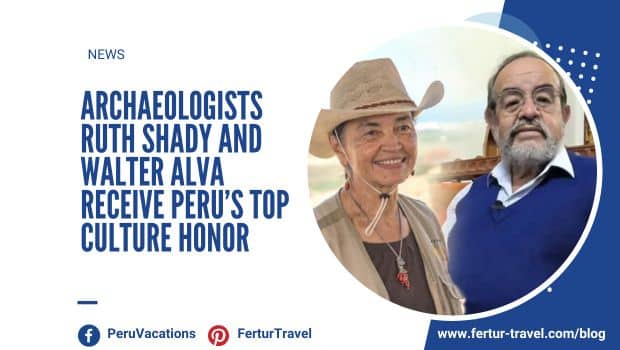
Peru Honors Walter Alva and Ruth Shady for Transforming Archaeology
Peru has awarded the Ministry of Culture’s highest distinction to Walter Alva and Ruth Shady, two archaeologists whose work changed how Peru — and the world — understands the ancient Americas.
The government granted each researcher the Order of the Great Masters of Peruvian Culture (Orden de los Grandes Maestros de la Cultura Peruana) in recognition of their contributions to the study, preservation and public understanding of Peru’s archaeological heritage. The awards were formalized through Supreme Resolutions No. 008-2026-MC and No. 009-2026-MC, published Tuesday, July 7, 2026, in the official gazette El Peruano.
Both received the honor for their work protecting and promoting places and objects designated as Cultural Heritage of the Nation. Specialized evaluation committees unanimously recommended each archaeologist for the distinction.
The two careers span different regions and periods of ancient Peru. Alva’s name is inseparable from the Lord of Sipán and the Moche civilization of the north coast. Shady’s research at Caral pushed the history of complex urban society in the Americas back nearly 5,000 years, helping place pre-Columbian Peru as the world’s Sixth Cradle of Civilization.
The Honor at a Glance
- Honorees: Walter Alva (Lord of Sipán, Moche civilization) and Ruth Shady (Sacred City of Caral)
- Award: Order of the Great Masters of Peruvian Culture — the Ministry of Culture’s highest distinction
- Formalized: Supreme Resolutions No. 008-2026-MC and No. 009-2026-MC, published July 7, 2026, in El Peruano
- Category: Revalorization and protection of property declared Cultural Heritage of the Nation
- Why it matters: Alva led the 1987 rescue excavation of the Lord of Sipán tomb; Shady’s research dated Caral to about 5,000 years ago — the oldest known center of civilization in the Americas
- See their work: Royal Tombs of Sipán Museum in Lambayeque; Sacred City of Caral, about 200 km (124 miles) north of Lima
1. Walter Alva and the Rescue of Sipán
At Sipán, historic archaeological discovery began as an emergency.
In 1987, looters broke into the adobe pyramids of Huaca Rajada, near Chiclayo, and started selling extraordinary Moche objects on the illegal antiquities market. Alva and his team intervened, secured the site and led the scientific excavation that uncovered the tomb of the Lord of Sipán.
The burial revealed a Moche ruler surrounded by ceremonial regalia, ornaments, offerings and accompanying burials. More important than the gold itself was the archaeological context. The carefully recorded placement of each object allowed researchers to reconstruct aspects of Moche political authority, religion, craftsmanship and funerary ritual that isolated artifacts could never have explained.
The government’s resolution recognizes more than that celebrated excavation. It also highlights Alva’s long campaign against looting and illegal trafficking, his role in developing museums in Lambayeque and his work training new generations of Peruvian archaeologists.
The Royal Tombs of Sipán Museum now presents the excavated objects within the broader story of Moche society. Its collections are not merely treasures recovered from a tomb. They are evidence preserved through one of the most important archaeological rescue efforts of the 20th century.
2. Ruth Shady and the True Importance of Caral
Ruth Shady’s achievements at Caral were less dramatic, but no less historic.
She did not encounter ruins that were entirely unknown. Archaeologists had previously recorded ancient sites in the Supe Valley. What remained unclear was their age, scale and place in the development of civilization in the Americas.
Beginning in 1994, Shady led sustained, multidisciplinary research at Caral. Excavations and radiocarbon dating demonstrated that the city developed about 5,000 years ago, making it the oldest known center of civilization in the Americas.
Her team documented monumental platform buildings, sunken circular plazas, residential sectors and evidence of specialized economic, ceremonial and administrative activity. The findings showed that a highly organized urban society had emerged on Peru’s north-central coast at roughly the same broad period as the early civilizations of Egypt and Mesopotamia.
The Sacred City of Caral-Supe was added to the UNESCO World Heritage List in 2009. UNESCO describes it as an exceptionally well-preserved, 5,000-year-old archaeological site and the oldest center of civilization in the Americas.
The resolution honoring Shady also recognizes more than three decades of research, conservation and public education. Her work established Caral not simply as an ancient place to be excavated, but as a cultural landscape requiring long-term protection and responsible management.
3. More Than Two Archaeological Discoveries
News headlines often describe Alva and Shady as the “discoverers” of the Lord of Sipán and Caral. That shorthand obscures the larger importance of their work.
Alva helped stop an archaeological catastrophe. His team recovered the Lord of Sipán through controlled excavation before looters could destroy the tomb’s remaining context.
Shady demonstrated the true antiquity and complexity of Caral through years of research. Her work transformed a group of previously known ruins into evidence for an early civilization that forced archaeologists to reconsider how and when urban society developed in the Americas.
Both then faced the more difficult task that comes after excavation: protecting sites, organizing collections, building institutions, publishing results and persuading the public that archaeological heritage matters.
The Order of the Great Masters of Peruvian Culture recognizes that complete process. Archaeology does not end when an object emerges from the ground. Its lasting value depends on what happens next.
4. Visiting the Places Behind the Honor
Travelers can encounter the results of Alva’s work in Lambayeque, where Huaca Rajada and the Royal Tombs of Sipán Museum form part of the archaeological circuit around Chiclayo. The region also includes Túcume, the Brüning National Archaeological Museum and other sites connected to the Moche and Lambayeque cultures.
Caral lies about 200 km (124 miles) north of Lima, on a desert terrace overlooking the Supe Valley. Its monumental buildings and circular plazas offer a view of Peruvian history thousands of years before the rise of the Inca Empire.
The two destinations are separated by geography and by millennia, but they communicate the same lesson: Peru’s archaeological record is far deeper and more diverse than any single civilization.
By honoring Walter Alva and Ruth Shady, Peru has recognized two scholars who not only expanded that record, but also fought to preserve it for the generations that follow.
5. FAQ: Walter Alva, Ruth Shady, and Peru’s Highest Cultural Honor
Who are Walter Alva and Ruth Shady?
Walter Alva and Ruth Shady are Peru’s two most internationally recognized archaeologists. Alva led the 1987 rescue excavation of the tomb of the Lord of Sipán at Huaca Rajada, near Chiclayo — one of the most important archaeological finds of the 20th century — and went on to build the Royal Tombs of Sipán Museum in Lambayeque. Shady has directed research at Caral since 1994, where her team demonstrated that the city developed about 5,000 years ago, making it the oldest known center of civilization in the Americas. In July 2026, both received the Order of the Great Masters of Peruvian Culture, the Ministry of Culture’s highest distinction.
What is the Order of the Great Masters of Peruvian Culture?
The Order of the Great Masters of Peruvian Culture (Orden de los Grandes Maestros de la Cultura Peruana) is the highest recognition Peru’s Ministry of Culture can bestow. It is granted by supreme resolution — signed at the level of the national government — in defined subcategories, following the recommendation of specialized evaluation committees. Alva and Shady were each honored in the subcategory for the revalorization and protection of property declared Cultural Heritage of the Nation, through Supreme Resolutions No. 008-2026-MC and No. 009-2026-MC.
Can travelers visit Sipán and Caral?
Both places connected to these honors are open to visitors, though they sit at opposite ends of a long stretch of Peru’s coast. Alva’s legacy is concentrated around Chiclayo, in the Lambayeque region, where the Royal Tombs of Sipán Museum displays the excavated burial treasures and the Huaca Rajada site preserves the pyramids where the tomb was found. Caral is visited as a full-day trip from Lima: the site lies about 200 km (124 miles) north of the capital in the Supe Valley, and the drive takes roughly three and a half to four hours each way.
Why is Caral called the oldest civilization in the Americas?
Radiocarbon dating carried out during Ruth Shady’s excavations, which began in 1994, demonstrated that Caral’s monumental architecture was built about 5,000 years ago — roughly the same broad period as the early civilizations of Egypt and Mesopotamia, and far earlier than any comparable urban center then known in the Western Hemisphere. UNESCO added the Sacred City of Caral-Supe to the World Heritage List in 2009, describing it as the oldest center of civilization in the Americas.

Related Posts
Comments (0)