For most travelers, Peru’s history fascinates from the very first moment, but for others, the…
485 Years Ago Today: Francisco Pizarro Was Assassinated in Lima
On June 26, 1541, Francisco Pizarro was killed in Lima — not on a battlefield, not in the Andes, but inside the colonial city he had founded just six years earlier.
Today, June 26, 2026, marks 485 years since the assassination of the Spanish conquistador who led the conquest of the Inca Empire and founded Lima as the Ciudad de los Reyes — the City of Kings.
The Assassination of Francisco Pizarro — At a Glance
- Date: June 26, 1541
- Location: Pizarro’s palace, Lima — the city he founded six years earlier
- Who: Supporters of Diego de Almagro the Younger, avenging his father’s 1538 execution
- Significance: Ended the life of the conquistador who led the Spanish conquest of the Inca Empire and founded Lima as the Ciudad de los Reyes
- The mystery: For nearly a century, Lima Cathedral displayed the wrong body — the real remains were found in a sealed niche in 1977 and identified through forensic analysis
- Where to see: Lima Cathedral and Plaza Mayor, historic center of Lima
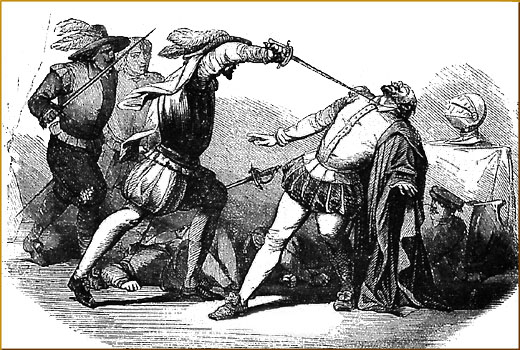
The killing was brutal, political and deeply personal. Pizarro’s attackers were heavily armed supporters of Diego de Almagro the Younger, son of his former associate and later rival. The elder Almagro had been executed in 1538 after the bitter civil war between the Pizarro and Almagro factions. Three years later, his supporters came for Pizarro.
On June 26, 1541, they stormed Pizarro’s palace in Lima and assassinated him.
Accounts describe an aging Pizarro fighting back fiercely before being overwhelmed and stabbed. His half-brother, Martín de Alcántara, was also killed.
It was a violent end to one of the most consequential and contested figures in Peruvian history.
1. A death that shaped colonial Peru
Pizarro’s assassination did not end the conquest, but rather marked the next struggle for power among the Spaniards bent on carving up the spoils from the Inca world.
The Inca Empire was already shattered. Cusco had fallen. Atahualpa had been captured and executed. Lima was established on the central coast as the new Spanish capital, chosen for its access to the Pacific and its proximity to Pachacámac — the venerated spiritual center that was a vitally important center of strategic power.
But the conquest did not produce unity among the victors. The Pizarro and Almagro factions fought over land, titles, wealth and legitimacy. The assassination in Lima was part of that larger civil conflict. The Spanish conquistadors would continue to be locked in murderous rivalries within their own ranks. They would also openly challenge the Spanish throne’s right to dictate how they exploited resources and the native population, already devastated by smallpox, measles and typhus brought by the European invaders.
For travelers walking through Lima’s historic center today — a UNESCO World Heritage site — that history is not abstract. The Plaza Mayor, the Government Palace, Lima Cathedral and the surrounding streets still mark the geography of Spanish colonial power. Pizarro’s life and death are woven into that urban landscape.
2. The mystery after the murder
The assassination itself was well documented. The mystery came later.
The question investigators eventually set out to solve was what had happened to Pizarro’s body after the killing — and why Lima Cathedral had ended up venerating the wrong remains.
Pizarro was first buried hurriedly behind the church. In 1544, after his supporters regained control, his body was reinterred with honors beneath the main altar.
Over the following decades, the church expanded into the cathedral that still dominates Lima’s historic center. Earthquakes, renovations and transfers complicated the record of where Pizarro’s remains had been placed.
A key document from 1661 later described an important exhumation. According to that account, Pizarro’s skull was placed in a lead box, while his bones were placed in a separate wooden box wrapped in velvet.
But by the late 19th century, Lima Cathedral was displaying a different body: a salted, partially preserved mummy in a glass sarcophagus. For decades, visitors were told that this was Pizarro. Officials honored it as the body of the conqueror of Peru.
Later forensic work would show that attribution was mistaken.
The modern mystery began on June 18, 1977, when workers remodeling the crypt of Lima Cathedral accidentally opened a sealed niche.
Inside they found a lead box with a rough inscription identifying its contents as the skull of Francisco Pizarro. Beside it was a wooden crate containing bones wrapped in velvet.
The discovery raised an extraordinary question.
If Pizarro’s skull and bones had been hidden in the cathedral crypt, then whose mummy had Lima been displaying for nearly a century?
The answer required years of careful work. Peruvian and international specialists — archaeologists, anthropologists, pathologists, radiologists, chemists and historians — examined the mummy, the newly discovered bones, the inscriptions and the historical record.
The crate held bones from several individuals, including a man, an elderly woman and two children. But one male skeleton matched what investigators expected to find: a man of Pizarro’s age, from the right historical period, bearing the marks of a violent death.
The skull fit the skeleton. It also showed traces consistent with long storage in a lead box. Most important, the wounds in the bones matched the 16th-century accounts of Pizarro’s assassination.
4. Forensic science enters the story
The evidence pointed away from the mummy that had long been displayed and toward the remains found in the hidden niche.
The skull and bones showed injuries consistent with a close-range attack: cuts and blows to the head and neck, along with wounds that fit the story of a man fighting for his life.
X-rays and microscopic analysis showed a sword wound under the jaw that penetrated toward the vertebrae, consistent with accounts describing a fatal thrust to the throat and neck. Other injuries suggested desperate defensive movements, including damage to the sword hand and elbow.
The murder had been preserved not only in chronicles, but in the bones themselves.
The conclusion was clear: the remains found in the hidden niche were Pizarro’s. The mummy long displayed in the cathedral was not.
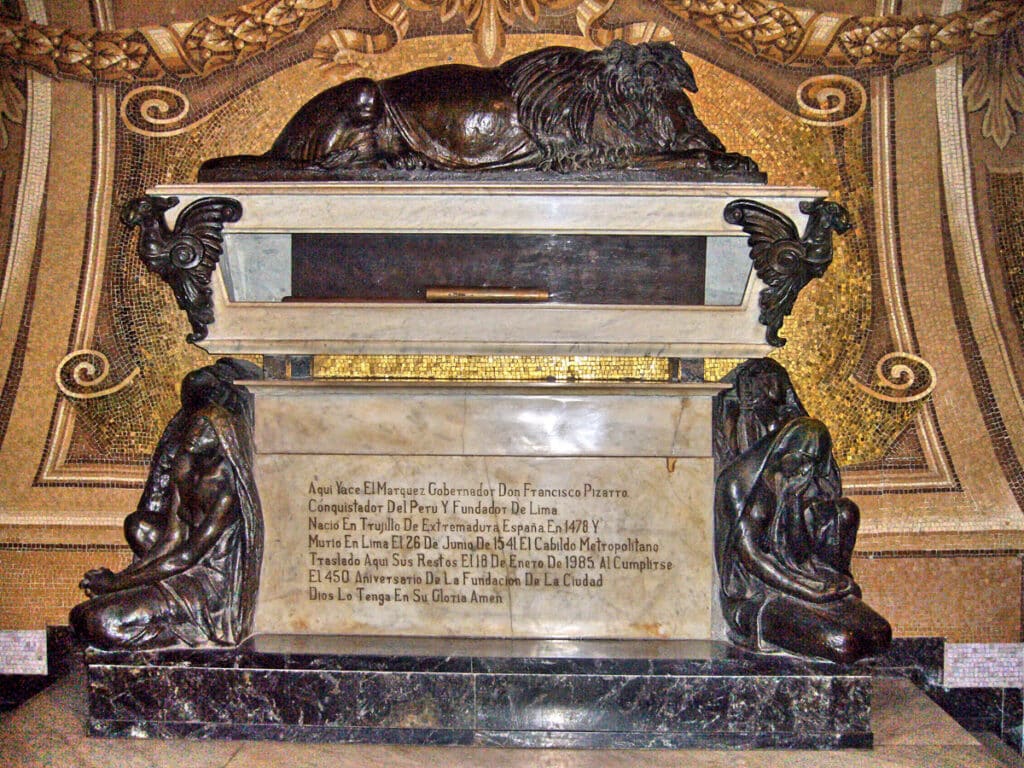
In January 1985, 444 years after his assassination, the real remains of Francisco Pizarro were placed in his public crypt in Lima Cathedral, ending one of Peru’s strangest historical mysteries.
“How the mystery of Francisco Pizarro was solved“ is a fascinating story that traces the forensic investigation that corrected a long-standing historical error.
5. Why this anniversary matters
Pizarro remains a difficult figure.
He is central to the history of Lima and the Spanish conquest of Peru, but that history cannot be separated from the collapse of the Inca state, the violence of conquest and the colonial order that followed.
That is precisely why anniversaries like this matter.
They give us a chance to look again — not to simplify the past, but to understand it more clearly. Lima is not only a modern capital of food, museums, neighborhoods and ocean views. It is also a city layered with conquest, resistance, religious power, republican change and unresolved memory.
The story of Pizarro’s assassination brings those layers into focus. It connects the Plaza Mayor to the conquest of the Andes, Lima Cathedral to forensic science, and a 16th-century political murder to a 20th-century archaeological mystery.
Four hundred eighty-five years later, the event still belongs to the history of the city.
And in Lima, history is rarely far below the surface.
6. The statue that still divides the city
The forensic questions about Pizarro’s remains were settled in 1985. The political questions about how Lima should remember him are not.
For most of the 20th century, an equestrian statue of Pizarro stood at the symbolic heart of the city he founded. Inaugurated in January 1935 for the 400th anniversary of Lima’s Spanish foundation, it was placed prominently on the Plaza Mayor — until the Archdiocese complained that the horse’s rear faced the cathedral, prompting a move in 1952 to an adjoining square next to the Government Palace that was renamed Plaza Pizarro.
The debate sharpened in the early 2000s. Mayor Luis Castañeda Lossio ordered the statue removed as part of a remodeling of the historic center. Plaza Pizarro became Plaza Perú. The statue was relocated to a corner of Parque de la Muralla, behind the Government Palace, beside the remnants of the colonial wall — a symbolic demotion that satisfied nobody. Supporters of removal called Pizarro a thief and an invader with no place at the city’s civic core. Defenders called him the city’s founder and argued that removal erased rather than contextualized history.
In early 2025, under a right-leaning municipal administration, the statue was brought back to the historic center for Lima’s 490th anniversary, installed on an elevated plinth on Pasaje Santa Rosa — a bucolic side street leading toward the Plaza Mayor, but not on it. Indigenous organizations condemned the return as an insult. The mayor’s office framed it as restoring the founder to his city.
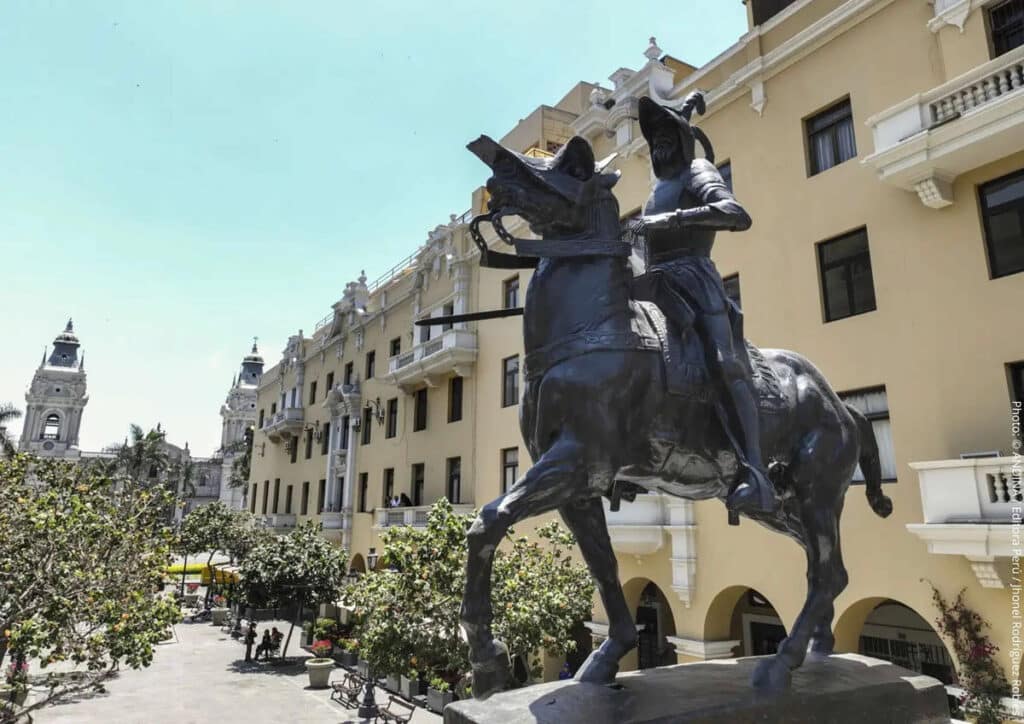
The Pasaje Santa Rosa placement is, in this writer’s view, where the statue belongs: present in the historic center, because Pizarro is inseparable from Lima’s founding, but not occupying its most ceremonial space. That distinction matters. It is not a full rehabilitation, and it is not erasure. Whether it satisfies anyone is another question.
One further detail worth noting: there are credible questions about whether the statue accurately depicts Pizarro at all. The rider’s feathered helmet, horse type, and sword style align more closely with generic conquistador imagery — or possibly Hernán Cortés — than with what is known of Pizarro. Lima has been debating the placement of a monument that may not even be a reliable likeness of the man.
That ambiguity fits the broader story. Pizarro remains a figure defined by contested accounts — of his origins, his methods, his death, and now his image. The statue’s successive relocations map the arc of that contest: from cathedral atrium to side square, to an out-of-the-way park, and back again to a side street near the historic plaza.
Visit historic Lima with context
A visit to Lima’s historic center is more rewarding when the buildings are seen not only as monuments, but as evidence: of empire, faith, conflict, adaptation and survival.
Lima Cathedral, the Plaza Mayor and the surrounding colonial streets are essential stops for travelers interested in Peru’s history. They also offer a starting point for deeper conversations about how Peru remembers the conquest — and how modern archaeology continues to revise what we thought we knew.
And if you would like to explore Lima with expert local context, Fertur Peru Travel can help arrange private and custom-guided visits through the historic center, from the colonial core to the museums and neighborhoods that tell the wider story of Peru.

Related Posts
Comments (0)