A 12-day adventure spanning ancient Inca ruins, the mystical Lake Titicaca, and the breathtaking Bolivian…
Ausangate Trek: Peru’s Sacred Mountain and the Rainbow Landscape
For travelers looking beyond Peru’s classic routes, the Ausangate Trek offers one of the Andes’ most powerful high-altitude experiences.
Set in the Vilcanota Mountain Range southeast of Cusco, this 5-day journey passes through snow-covered peaks, mineral-rich lagoons, remote pastoral landscapes, and living Andean tradition.
This trek is defined not only by what you see, but by how the landscape feels. The open puna and high valleys give the route a powerful sense of scale. The slow rhythm of herding life shapes the experience. And throughout the journey, the constant presence of Ausangate gives the trek its deeper meaning.
For many travelers, this is one of the most memorable multi-day treks in Peru. It offers dramatic natural beauty, a stronger sense of remoteness than Peru’s busier hiking routes, and a rare opportunity to experience a mountain region that remains deeply connected to Andean culture.
Ausangate Trek: 5-Day Guided Circuit from Cusco
Snow peaks, mineral-colored lakes, alpaca herds moving across open puna, the silence of high passes above 5,000 meters. Ausangate is one of the Peruvian Andes’ most powerful mountain journeys—and one of its least crowded.
Our 5-day guided circuit handles transport, camps, meals, and logistics so you can focus entirely on the landscape.
Overview of Ausangate Trek
Open
Why the Ausangate Trek Stands Out
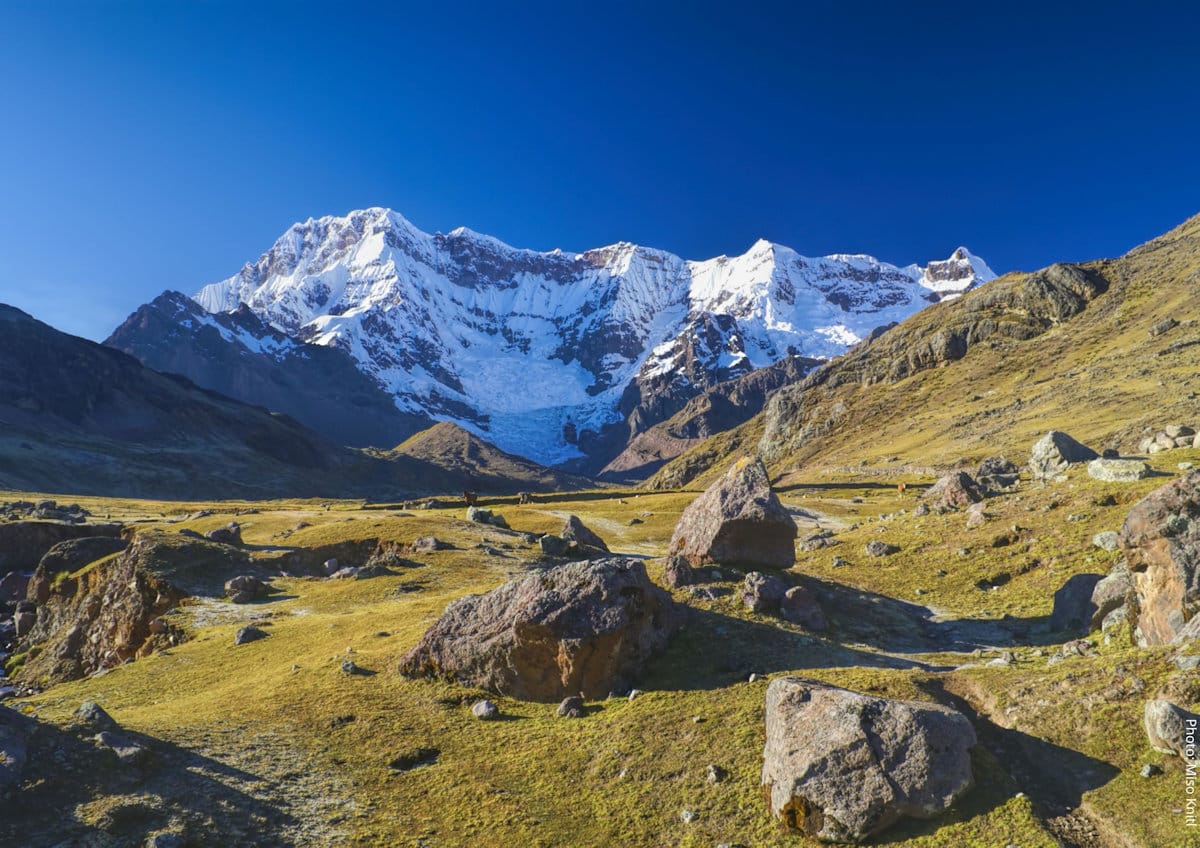
That combination of scenery, altitude, and cultural meaning is what makes the Ausangate Trek one of the most distinctive trekking experiences in Peru.
Over the course of five days, travelers cross high passes, walk beside vivid glacial lakes, camp beneath immense snow peaks, and move through one of the most spiritually important mountain regions in southern Peru.
Ausangate is revered locally as an Apu, a sacred mountain spirit in Andean cosmology. The route therefore carries both scenic and cultural depth.
It is not simply a demanding hike through striking terrain. It is a journey through a landscape that nearby communities continue to regard with reverence.
Where the Ausangate Trek Is Located
Ausangate rises about 62.1 miles (100 kilometers) southeast of Cusco in the Vilcanota Mountain Range, spanning parts of the Quispicanchi and Canchis provinces. At 20,945 feet (6,384 meters), it is the highest peak in the Cusco region and one of the most imposing mountain presences in the Peruvian Andes.
The trekking route unfolds through a vast high-altitude world of puna grasslands, glacial valleys, wetlands, and colorful lagoons. The scenery shifts constantly. One section may open onto broad golden plains with grazing alpacas, while the next reveals turquoise water, red-tinted slopes, or towering glacial walls.
Locally, many people describe Ausangate as an Apu that “gathers or unites the family,” highlighting its role as a protective presence in the Andean world. More broadly, the mountain is associated with water, fertility, and balance, and its glaciers feed important waterways across the region.
What You Will See on the Ausangate Trek
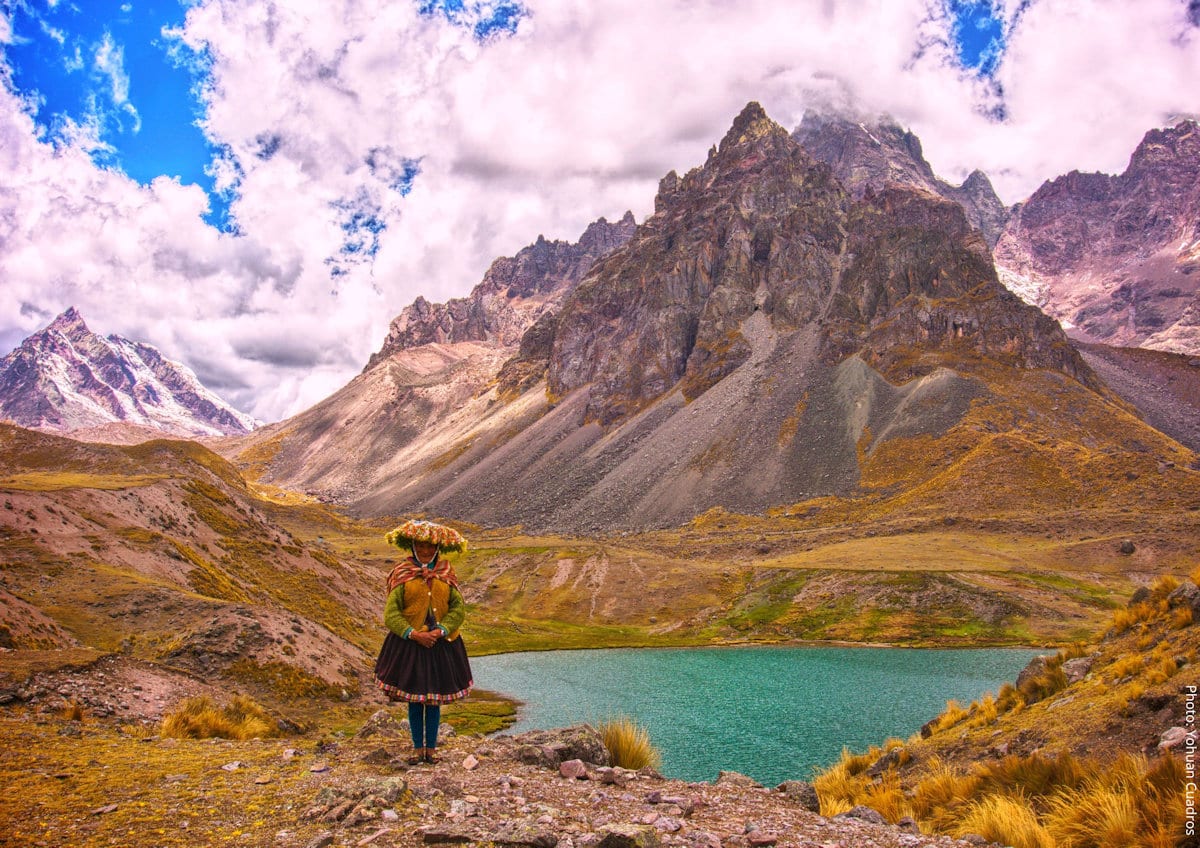
The Ausangate Trek is one of Peru’s most visually rewarding mountain routes. Across five days, the trail reveals a remarkable variety of landscapes shaped by ice, altitude, and mineral-rich geology.
Travelers can expect to see:
- Snow-covered peaks dominating the skyline
- High mountain passes above 16,404 feet (5,000 meters)
- Lagoons in shades of turquoise, blue, rust, and green
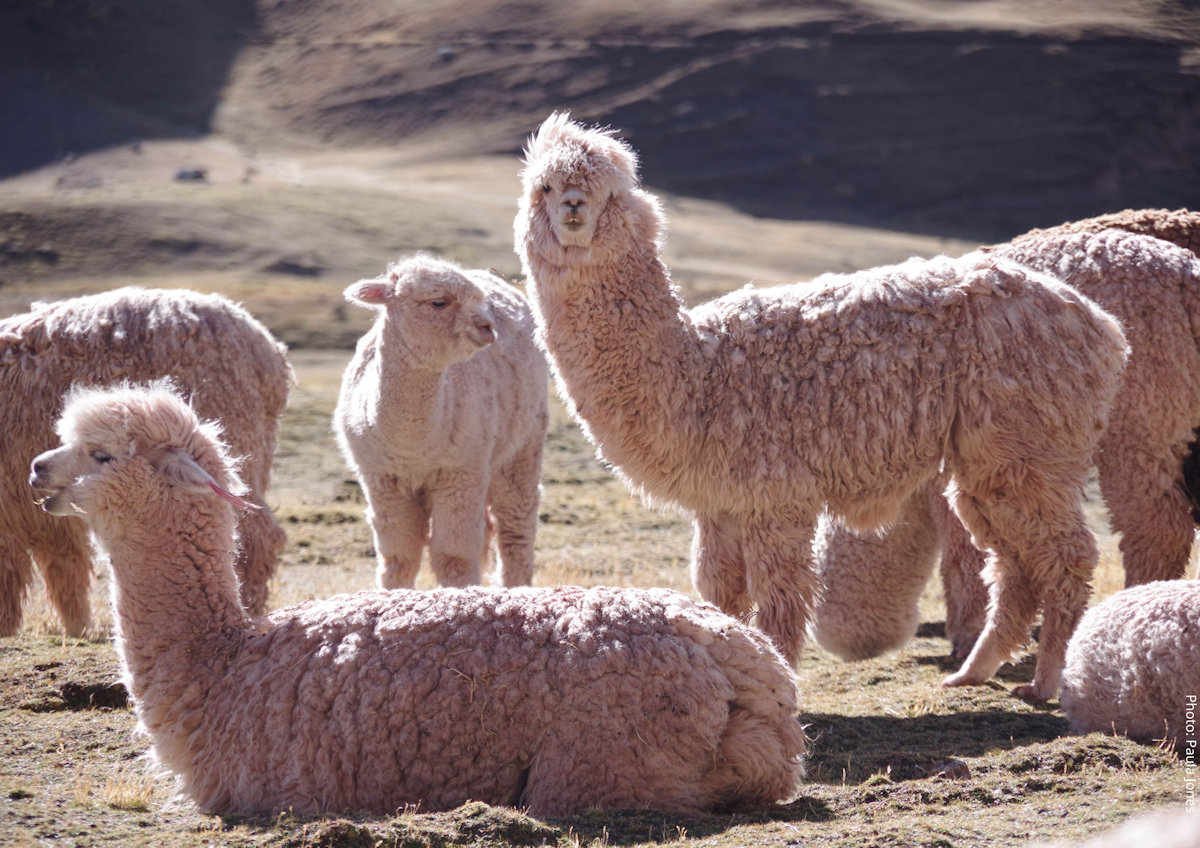
- Herds of alpacas and llamas grazing across open valleys
- Remote Andean communities tied to pastoral traditions
- Broad puna landscapes with an exceptional sense of space
- Thermal springs near Pacchanta at the end of the route
Among the most memorable natural features are the region’s glacial lakes. Puca Q’ocha, Azul Cocha, and Ausangatecocha are among the best known, and each brings a different combination of color, light, and mountain backdrop.
Wildlife adds another dimension to the trek. Andean condors may be seen overhead, while vizcachas appear among the rocks and birdlife animates the highland wetlands.
The Cultural Meaning of Ausangate
One of the reasons this route leaves such a strong impression is that it is not only scenic. It is also deeply cultural.
In Andean belief, Apus are living mountain beings connected to specific territories and to the wellbeing of the people who live around them. Ausangate is one of the most important of these sacred peaks. Local traditions continue to link the mountain with protection, water, agriculture, and the reciprocal relationship between people and the natural world.
Offerings known as despachos, often prepared with coca leaves and symbolic ritual elements, remain part of this spiritual tradition. The annual Qoyllur Rit’i pilgrimage, one of the most important religious events in the Peruvian Andes, also takes place in the shadow of these mountains.
For travelers, this adds depth to every stage of the route. The landscapes are extraordinary on their own, but understanding that this is also a sacred region gives the trek a more meaningful dimension.
📌 If the Ausangate Trek sounds like the right challenge for you, we encourage you to reach out through WhatsApp or the Contact Us form for a quote and more information about our Ausangate Trek 5-day program.
How Long Is the Ausangate Trek?
The classic Ausangate Trek is most often completed as a 5-day circuit, which allows time to experience the route at a steady pace while crossing its major passes and enjoying some of the most dramatic campsites in the region.
As a general guide, the full 5-day route usually covers about 37.3 to 43.5 miles (60 to 70 kilometers), depending on the exact itinerary and campsite arrangement. Shorter programs also exist in the wider Ausangate region. Some 2-day routes cover about 8.1 miles (13 kilometers), often focusing on the Seven Lakes area. Some 3-day programs total roughly 15.5 to 18.6 miles (25 to 30 kilometers). Some 4-day routes cover about 28 to 31.1 miles (45 to 50 kilometers). Still, the 5-day format remains the most complete way to experience the mountain.
Most itineraries begin and end near Tinki, the traditional gateway to the circuit.
How Difficult Is the Ausangate Trek?
This is considered a challenging high-altitude trek and should be approached with proper preparation.
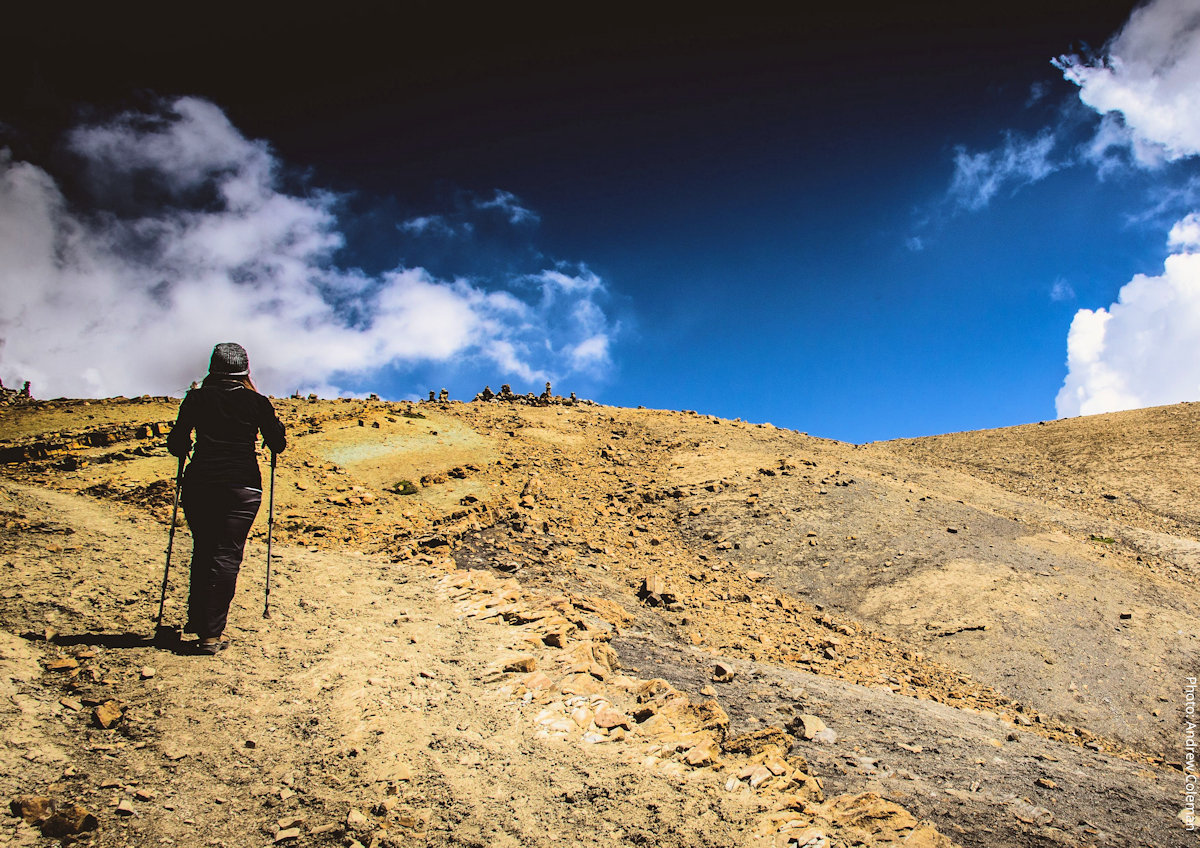
The difficulty comes less from technical terrain and more from the combination of long hiking days, cold nights, and sustained elevation above 13,123 feet (4,000 meters). Several passes rise above 16,404 feet (5,000 meters), including Palomani Pass, which is usually cited as the highest point on the route at between 16,571 and 17,060 feet (5,051 and 5,200 meters).
On many commercial 5-day itineraries, daily hiking distances begin moderately and build toward the middle of the trek. A shorter first day may cover about 4.3 to 6.2 miles (7 to 10 kilometers). The longest day often falls around the second or third stage, at roughly 6.8 to 10.3 miles (11 to 16.5 kilometers). Later stages commonly cover about 5.9 to 7.8 miles (9.5 to 12.5 kilometers) before a shorter final return.
For travelers who arrive well acclimatized and choose a well-organized guided program, the challenge is manageable and highly rewarding. The key is to treat the altitude with respect and allow time to adjust before departure.
Best Time to Trek Ausangate
The most favorable season for the Ausangate Trek is generally the dry season, from May through September.
June and July often bring the clearest skies and the sharpest mountain views, though nighttime temperatures are especially cold. May, September, and early October can also be excellent months, often combining good trail conditions with slightly milder weather.
February is usually the least favorable month because of heavier rainfall, muddy trails, and possible route disruptions.
For travelers planning a Peru itinerary around trekking season in the Andes, Ausangate is usually at its best during the heart of the dry months.
What Is the Route Like Day by Day?
The exact structure varies by operator, but most 5-day itineraries follow a rhythm that builds gradually before easing toward the finish.
The opening day is often a shorter stage designed to settle into the route and continue acclimatization. The middle days bring the most demanding sections, including major mountain passes, broader distances, and the route’s most dramatic scenery. The final day usually returns through gentler terrain before ending near Pacchanta, where the thermal springs provide a satisfying close to the experience.
This progression works well for travelers because it balances physical challenge with scenic reward. The route never feels repetitive. Each day brings a different landscape, a different light, and a different perspective on the mountain.
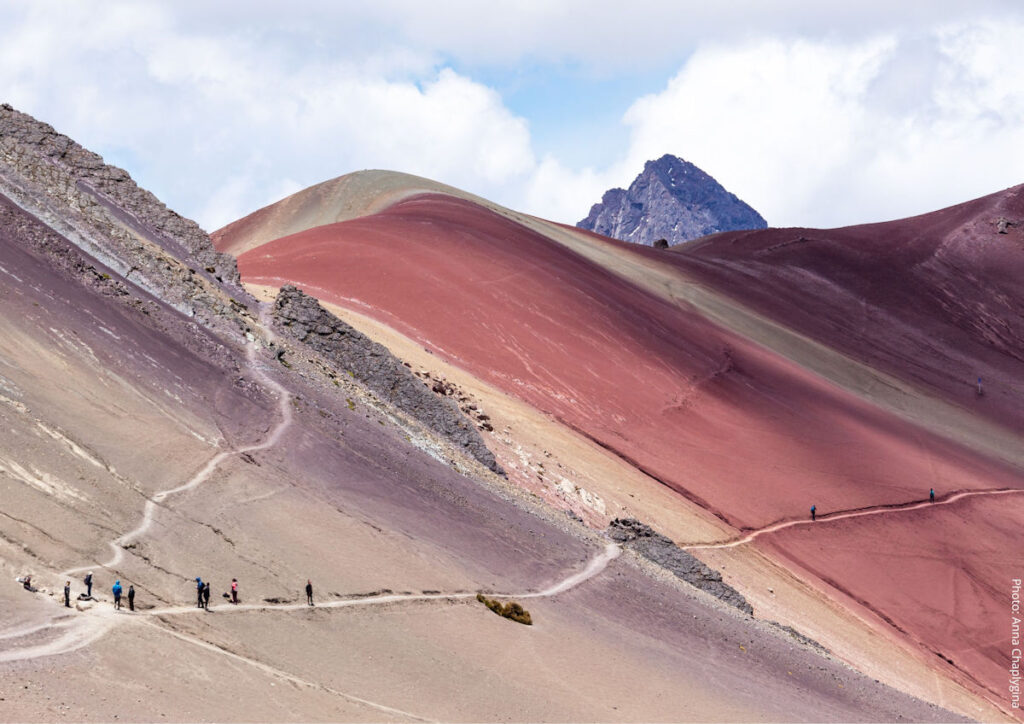
Ausangate and Rainbow Mountain
One of the most appealing extensions of the Ausangate experience is the possibility of adding Rainbow Mountain, or Vinicunca, to the broader itinerary.
Seen in the context of the Ausangate region, Rainbow Mountain feels less like an isolated photo stop and more like part of a larger high-Andean landscape shaped by color, altitude, and mineral-rich geology. Some longer routes approach it in a way that avoids the busiest part of the standard day-tour traffic from Cusco, making the experience feel more connected to the surrounding mountain world.
For travelers who want to combine one of Peru’s most dramatic trekking circuits with one of its best-known natural landmarks, this can be an especially appealing option.
Why Choose a Guided Ausangate Trek
Because of the altitude, remoteness, and logistics involved, Ausangate is best experienced through a well-planned guided program.
A strong guided trek helps bring structure and reassurance to a route that would otherwise require careful coordination at every stage. Transport, camp logistics, meals, pacing, and local route knowledge all matter here. Just as important, experienced support allows travelers to focus on the landscape and the experience itself rather than the operational side of a demanding mountain circuit.
For many travelers, that support is what turns Ausangate from an ambitious idea into a comfortable and memorable part of a broader Peru trip.
What to Pack for the Ausangate Trek
Preparation makes a real difference on this route.
Waterproof hiking boots, warm layers, gloves, sun protection, and a sleeping bag suitable for temperatures around 14°F (-10°C) are all essential. Trekking poles are also highly recommended, especially on steep descents and uneven sections of trail. Because conditions can shift quickly between frosty mornings and sunny afternoons, layered clothing is especially important.
A well-prepared pack contributes directly to comfort on the trail and to a stronger overall experience.
Why This Trek Belongs in a Peru Itinerary
The Ausangate Trek offers a side of Peru that feels larger, quieter, and more elemental than the country’s most visited destinations.
It combines dramatic mountain scenery with living Andean tradition, and it does so in a setting that still feels remote and dignified. For travelers drawn to meaningful landscapes, serious trekking, and the chance to experience the Peruvian Andes beyond the standard circuits, Ausangate stands out as one of the country’s most rewarding journeys.
This is the kind of route that stays in memory long after the trip is over: the changing color of the lakes, the silence of the high passes, the sight of alpaca herds moving through the valleys, and the constant presence of one of Cusco’s most sacred mountains.
Ausangate Trek: 5-Day Guided Circuit from Cusco
Snow peaks, mineral-colored lakes, alpaca herds moving across open puna, the silence of high passes above 5,000 meters. Ausangate is one of the Peruvian Andes’ most powerful mountain journeys—and one of its least crowded.
Our 5-day guided circuit handles transport, camps, meals, and logistics so you can focus entirely on the landscape.
FAQs
How many days do you need for the Ausangate Trek?
The classic Ausangate Trek is most often completed in 5 days, which allows time to experience the full circuit at a comfortable pace. Shorter programs in the region may run 2, 3, or 4 days, depending on the route.
How difficult is the Ausangate Trek in Peru?
It is considered a challenging high-altitude trek because of the elevation, cold temperatures, and multiple mountain passes above 16,404 feet (5,000 meters).
What is the highest point on the Ausangate Trek?
Palomani Pass is usually the highest point on the route and is commonly cited between 16,571 and 17,060 feet (5,051 and 5,200 meters) above sea level.
When is the best time to do the Ausangate Trek?
The best months are generally from May through September, during the dry season in the Peruvian Andes.
Can you combine Ausangate with Rainbow Mountain?
Yes. Some itineraries include Rainbow Mountain as part of a broader Ausangate trekking program.
Are the Pacchanta hot springs included at the end of the trek?
Many itineraries finish near Pacchanta, where travelers can often enjoy the thermal springs after completing the route. Local entry rates can change.

Related Posts


Comments (0)