Chachapoyas sits at 2,335 meters (7,660 ft) on the eastern flank of the Andes in…
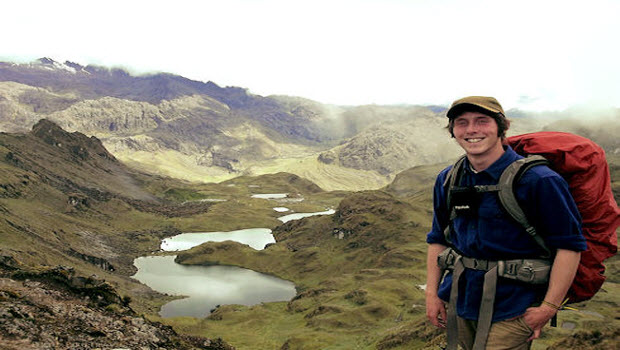
Machu Picchu is the climax after the Lares Valley Trek
The Lares Valley Trek is one of Peru’s finest alternatives to the classic Inca Trail — a four-to-five-day route through the Urubamba mountain range north of the Sacred Valley, crossing passes above 4,700 meters (15,400 ft), descending through cloud forest, and passing through Quechua-speaking communities where traditional weaving and pastoral life continue largely unchanged. The trek finishes at Ollantaytambo, with a guided sunrise visit to Machu Picchu on the final morning. Unlike the heavily permitted Inca Trail, Lares has no daily quota, keeping the trail genuinely uncrowded even in high season.
Lares Valley Trek at a Glance
- Route: Cusco → Cuncani → Chancachacan Valley → Lares hot springs → Ollantaytambo → Machu Picchu
- Duration: 4–5 days trekking + 1 day Machu Picchu
- Distance: Approx. 30–40 km (19–25 miles) on trail
- Highest point: ~4,700 m (15,400 ft) at the main pass
- Difficulty: Moderate — good cardiovascular fitness required; 6–8 hours hiking on the two main days
- Best season: May–October (dry season); clearest skies in June–July
- Permits: No Inca Trail permit required for the Lares route; timed-entry Machu Picchu ticket required (Fertur books this)
- Highlights: Nevado Sawasiray glacier views, Quechua village encounters, Lares thermal pools, sunrise at Machu Picchu
- Group style: Small-group (2–8) or fully private; porter and horse support included
What Is the Lares Valley Trek?
The Lares Valley Trek is a high-altitude hiking route in the Cusco region that winds through the Urubamba mountain range north of the Sacred Valley. Over four to five days, trekkers cross passes reaching nearly 4,700 meters (15,400 ft), descend through cloud forest, pass glacial lakes and thundering waterfalls, and walk through Quechua-speaking communities where traditional weaving, agriculture, and pastoral life continue largely unchanged. The trek finishes at Ollantaytambo, from where you board the train to Aguas Calientes and on to Machu Picchu the following morning. The route does not require the limited permits that govern the classic Inca Trail, making it easier to book and far less congested on the trail itself.
Why Choose Lares Instead of the Classic Inca Trail?
- Far fewer crowds — no permit quotas means the trail stays quiet, even in high season.
- Authentic cultural encounters — you pass through living Quechua villages, not archaeological sites, and meet weavers, farmers, and herders along the way.
- Spectacular and varied scenery — snow-capped peaks, high-altitude tundra, glacial lakes, cascading waterfalls, and cloud forest all in a single route.
- Hot springs at Lares — natural thermal pools make for a well-earned soak mid-trek.
- Flexible itinerary options — easier to customize with Sacred Valley extensions, extra rest days, or private departures than the rigidly permitted Inca Trail.
- Porter and horse support — your gear travels with the team so you hike with a light daypack.
- Same grand finale — the trek still ends with a guided sunrise visit to Machu Picchu.
Highlights of the Lares Route
The scenery shifts dramatically from one valley to the next, which is part of what makes the Lares route so compelling. Below are some of the standout moments you’ll encounter along the way.
Nevado Sawasiray and the High Glacier Peaks
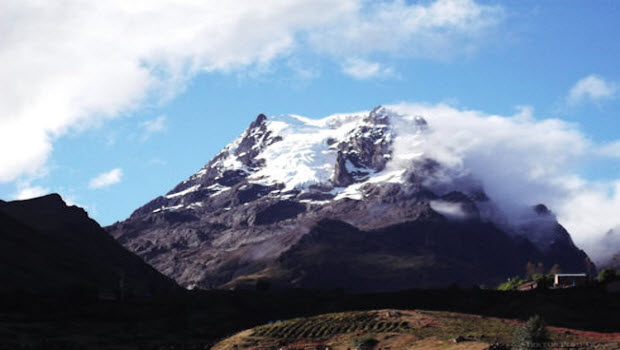
The snow-capped summits of Chicon, Pitusiray, Sawasiray, and Veronica dominate the skyline for much of the route. From the Cuncani campsite on the first night, Sawasiray fills the horizon — a reminder that you’re sleeping in the shadow of peaks that Andean communities have considered sacred for centuries.

Nevado Sawasiray viewed from the Cuncani campsite — the first night’s stop on the Lares trek.
Photo: Max Krieger
Andean Hamlets, Terraces, and Wildlife
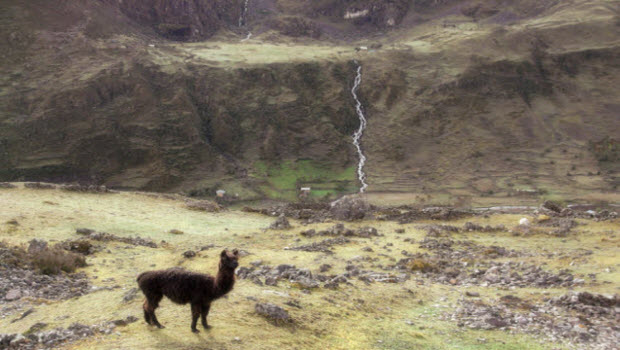
The valleys are dotted with small agricultural communities whose stone-walled terraces cling to steep hillsides. Herds of llama and alpaca graze across the high pastures, and encounters with local families — sometimes leading horse caravans loaded with thatch or wool — are among the most memorable moments of the trek.

A black llama grazes above an Andean hamlet. Below, agricultural terraces and a cascading waterfall mark a living community that has farmed this valley for generations.
Photo: Max Krieger

Alpaca on the rocky Chancachacan Valley mountainside — a common sight throughout the Lares route.
Photo: Max Krieger

A local couple leads their horse caravan through the Chancachacan Valley — the kind of spontaneous encounter that sets the Lares route apart.
Photo: Max Krieger
Lares Trek Itinerary Overview (4–5 Days)
Itineraries can be adjusted to your fitness level and interests. The outline below reflects our standard 4-day trek with Machu Picchu on day 5. A 5-day version adds a Sacred Valley rest day or extra time in Lares village.
- Day 1 — Cusco to Lares / First Camp: Transfer from Cusco through the Sacred Valley to the trailhead. Begin hiking through the first valley, passing local communities and acclimatizing to the altitude. Overnight at camp near Cuncani (approx. 3,900 m / 12,800 ft).
- Day 2 — High Pass and Glacial Lakes: The biggest day of ascent. Trek over the main pass (approx. 4,700 m / 15,400 ft) with panoramic views of the glacier peaks. Descend to camp near the Lares hot springs.
- Day 3 — Lares Hot Springs and Valley Descent: Soak in the natural thermal pools at Lares village, then continue descending through cloud forest and farming hamlets toward the valley floor. Overnight camp or lodge.
- Day 4 — Ollantaytambo and Train to Aguas Calientes: Transfer to Ollantaytambo in the Sacred Valley. Board the train through the Urubamba gorge to Aguas Calientes (Machu Picchu Pueblo). Overnight hotel in Aguas Calientes.
- Day 5 — Machu Picchu Guided Visit: Early morning bus to Machu Picchu for sunrise. Guided tour of the citadel, followed by free exploration time. Return train to Cusco in the afternoon.
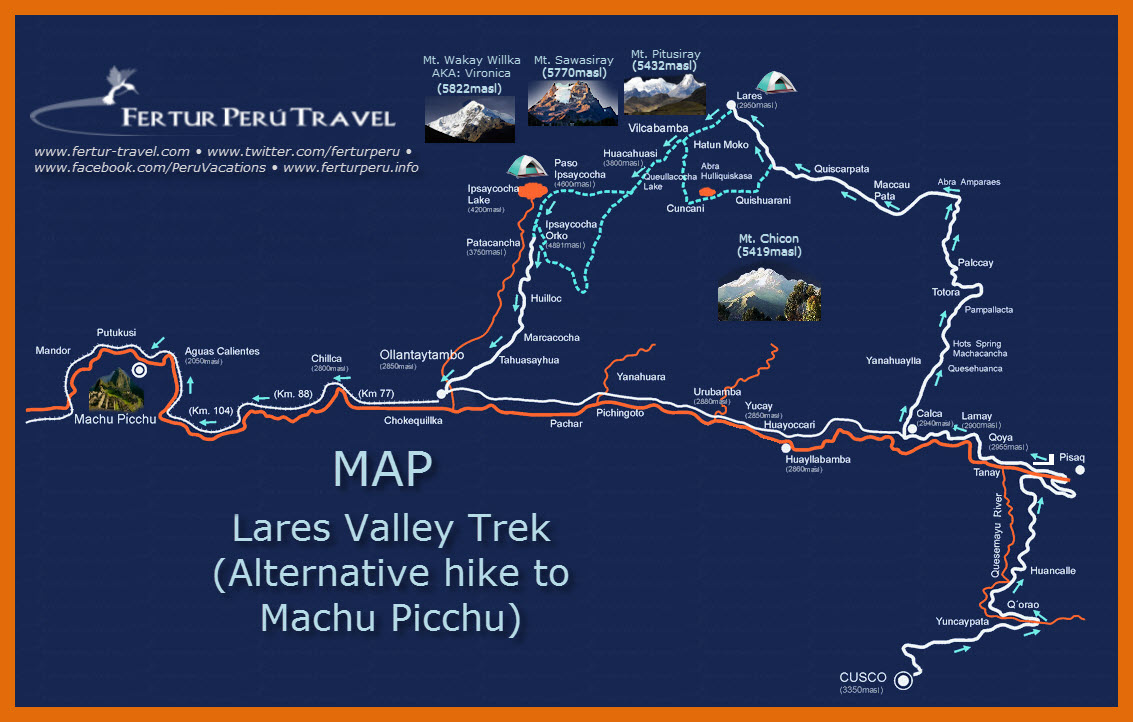
Route map of the 4–5 day Lares Valley trek, from the trailhead above Cusco through Cuncani, over the high pass, past Lares hot springs, and down to Ollantaytambo for the train to Machu Picchu. Click to enlarge.
Map: Fertur Peru Travel
Book Your Lares Valley Trek
Fertur Peru Travel designs custom Lares Valley treks in small-group and private formats, with full porter and horse support and a guided Machu Picchu finale. Contact us for a tailor-made itinerary — a MINCETUR-accredited agency with more than 30 years operating in Peru.
The Machu Picchu Finale: A Traveler’s Account
Max Krieger, a small-group trekker from Vermont who completed the luxury Lares Valley trek with Fertur, arrived at Machu Picchu on the final morning of his journey. He’d left his professional camera in Lima and picked up an inexpensive FujiFilm FinePix in Cusco for under $70 — and still came back with images that tell the whole story.
“The fast moving shroud of mist flowed close above the ground of the semitropical ridge, which is saddled between two spectacular mountain peaks. The fog burned off as the sun rose and we were able to see down to the Vilcanota River in the deep gorge below.”
— Max Krieger, Vermont, USA

The morning fog rolling over Machu Picchu at sunrise — the view that greets trekkers who arrive on the first bus up from Aguas Calientes.
Photo: Max Krieger
That early morning light is exactly why the Lares trek itinerary is designed to get you to Machu Picchu at opening — before the midday crowds arrive and the mist burns away completely. Max’s final reflection captures what so many Fertur clients describe after the journey:
“The morning fog, wafting over the ruins, added to the ambiance of mystery and ancient lore. It was a really beautiful natural spectacle that I’ll never forget.”
— Max Krieger, Vermont, USA

The reward at the end of the Lares Valley trek: an early morning arrival to Machu Picchu with a Fertur-guided tour of the citadel.
Photo: Fertur Peru Travel
Plan Your Lares Trek with Fertur
Fertur Peru Travel has been organizing Lares Valley treks since the route first gained international attention as an alternative to the classic trail. We operate both small-group departures (typically 2–8 travelers) and fully private treks, with experienced bilingual guides, licensed porters, horse support for gear and camping equipment, and quality meals prepared in camp. All Lares treks end with a guided visit to Machu Picchu, and we can extend your trip with Sacred Valley hotel stays, a Cusco city tour, or connections to other Peru destinations.
Browse our Machu Picchu trekking packages or contact our travel advisors directly to customize your Lares trek itinerary and Machu Picchu extension.
Plan Your Visit with Fertur
Fertur Peru Travel designs custom Lares Valley treks in small-group and private formats, with full porter and horse support and a guided Machu Picchu finale. Contact us for a tailor-made itinerary — a MINCETUR-accredited agency with more than 30 years operating in Peru.
Practical Information and Packing Tips
- Best time to trek: May through October (dry season). Skies are clearest in June and July. November through April brings rain and the occasional trail closure; some operators run treks in shoulder months (April, November) with acceptable conditions.
- Acclimatization: Plan at least two full days in Cusco (3,400 m / 11,200 ft) before the trek begins. Altitude sickness is common without proper acclimatization. Consult your doctor about acetazolamide (Diamox) if you are sensitive to altitude.
- Fitness level: Moderate hiking fitness is required. You’ll be walking 6–8 hours on the two main trekking days over terrain that includes steep ascents and descents. Regular cardio training in the months before the trip makes a significant difference.
- Gear basics: Layered clothing for cold nights and warm days; waterproof jacket and pack cover; sturdy broken-in hiking boots; trekking poles; sunscreen; sunglasses; personal blister kit. Your main bags travel by horse — you hike with a small daypack.
- Weather on the trail: Mornings are often clear; afternoon cloud build-up is common even in dry season. Temperatures at altitude drop significantly after dark. Base camp nights can be near freezing.
- Machu Picchu entry: Machu Picchu requires a timed-entry ticket booked in advance. Fertur secures these for you as part of the trek package.
Responsible and Community-Friendly Trekking
The communities along the Lares route depend on respectful, low-impact tourism. Fertur works with local porters and muleteers who are paid fair wages and provided with proper equipment and food. We follow leave-no-trace principles on the trail and encourage travelers to ask before photographing community members. When you buy local weavings or products from artisans along the route, you are supporting households that have maintained Andean traditions for generations. Travel thoughtfully, and the Lares Valley will leave a lasting impression on you — and leave the landscape intact for the next traveler.
Frequently Asked Questions
Do I need permits for the Lares trek?
No. The Lares Valley Trek does not use the classic Inca Trail route, so it is not subject to the 500-person-per-day permit limit. This makes it easier to book on shorter notice and keeps the trail far less crowded. You will, however, need a timed-entry ticket for Machu Picchu, which Fertur books on your behalf.
Is the Lares trek less crowded than the classic Inca Trail?
Yes, significantly. The Inca Trail is capped at 500 people per day (including guides and porters) and is booked out months in advance. The Lares route has no such restrictions and sees only a fraction of the foot traffic, meaning you’ll hike in genuine solitude for most of each day.
Can the Lares trek be combined with the classic Inca Trail or Sacred Valley stays?
Yes. We can build custom itineraries that add Sacred Valley hotel nights before or after the trek, incorporate Maras, Moray, or Pisac market visits, or extend your trip to Lake Titicaca, the Amazon, or northern Peru. Some travelers also choose to do the Lares trek on one visit and the classic Inca Trail on a return trip — they are quite different experiences and both are worth doing.
What is included in a Fertur Lares trek package?
Standard inclusions are: bilingual guide, licensed porters, horse or mule support for camping gear and group equipment, all meals on the trail (breakfast through dinner), camping equipment, train from Ollantaytambo to Aguas Calientes, hotel in Aguas Calientes, bus up to Machu Picchu, and guided Machu Picchu tour. Private treks and luxury upgrades (lodge-to-lodge options, premium tents) are available on request.
Is the Lares Valley Trek worth it compared to the classic Inca Trail?
The Lares trek offers something the classic Inca Trail cannot: genuine immersion in living Andean communities, with far fewer people on the trail and no permit scramble. You trade the famous Inca stonework along the trail itself for glacial lake scenery, hot springs, and spontaneous encounters with Quechua farmers and weavers — experiences that tend to stay with travelers longer than the archaeology does. The Inca Trail’s Sun Gate arrival at Machu Picchu is iconic, but the Lares route delivers the same Machu Picchu sunrise earned over terrain that is arguably more dramatic. If you have done the Inca Trail before, Lares is an easy choice. If it is your first Peru trek and cultural immersion matters as much as Inca history, Lares is the stronger pick. The two routes are different enough that doing both on separate visits is not at all redundant.
Start Planning Your Lares Trek
Fertur Peru Travel designs custom Lares Valley treks in small-group and private formats, with full porter and horse support and a guided Machu Picchu finale. Contact us for a tailor-made itinerary — a MINCETUR-accredited agency with more than 30 years operating in Peru.

Related Posts
Comments (0)